
"Survey on Happiness" - The turning point for happiness for Japanese people comes in their 60s!? The highest average happiness level is among men and women over 60. Satisfying "money," "body," and "mind" are the conditions for happiness.
2014.05.27
Press Releases
Culture Convenience Club Co., Ltd.
-The happiest model case is a "full-time housewife over 60 who enjoys gardening as a hobby"-
Culture Convenience Club Co., Ltd. is pleased to announce that it has conducted a "Survey on Happiness" using the "T Survey," an online survey of attitudes, targeting 1,525 male and female T members who use T cards.
Happiness Survey Results Digest
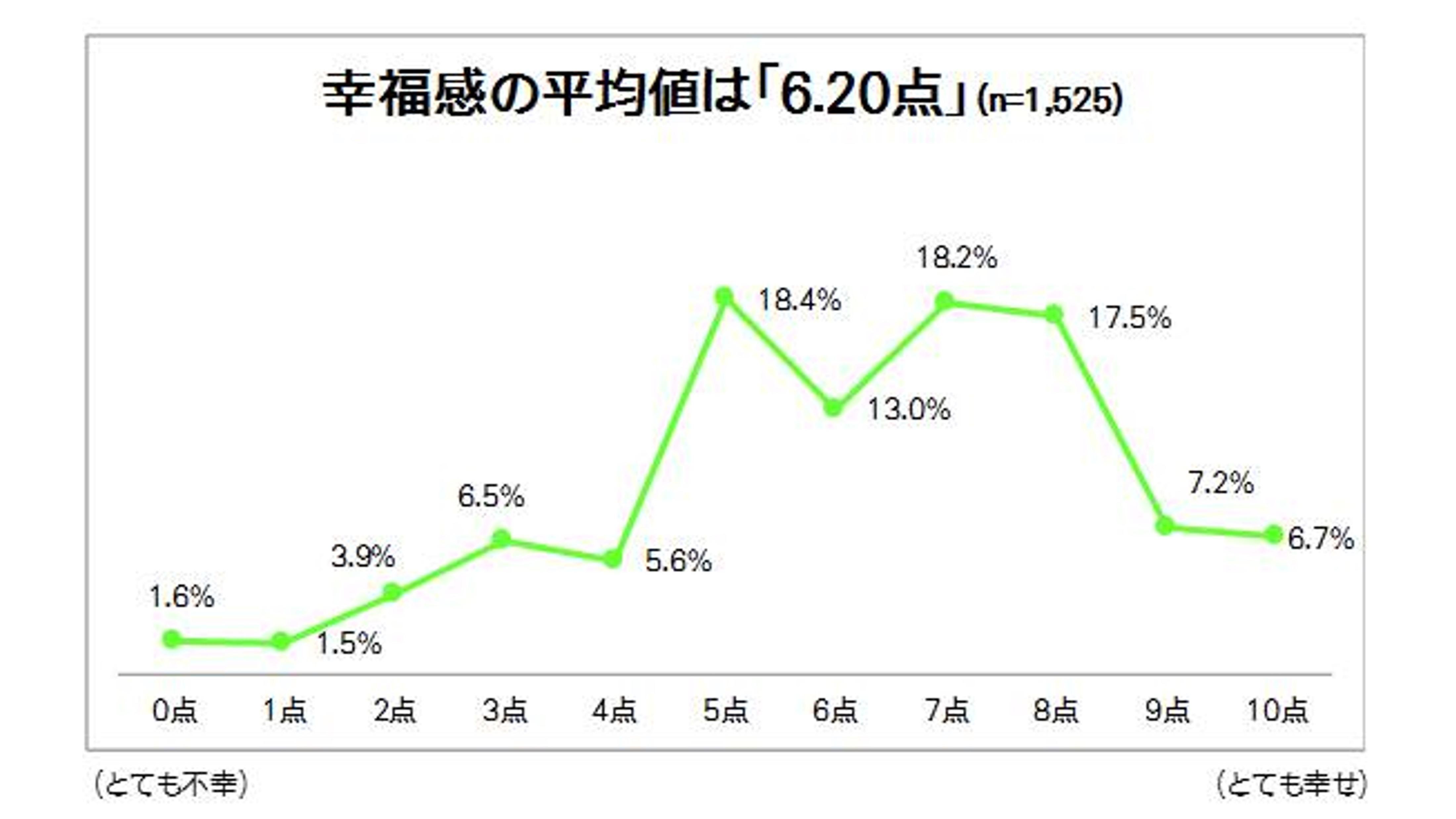
●The current average happiness score of Japanese people is 6.20 points
The average happiness score is higher for women (6.47 points) than for men (5.92 points).
The age group with the highest average happiness score is:
Men over 60 (6.94 points) and women over 60 (7.05 points)
The elements necessary for happiness are: 1st place "income," 2nd place "health," and 3rd place "mental freedom."
The top five happiest jobs are: 1st place "full-time housewife/househusband," 2nd place "professional/technical occupation," 3rd place "company manager/executive," 4th place "civil servant," and 5th place "student."
The top five hobbies that bring happiness are: 1st place "horticulture/gardening," 2nd place "knitting/crafts," 3rd place "cooking/gourmet food," 4th place "travel/sightseeing," and 5th place "jogging/walking."
The current average happiness score for Japanese people is 6.20 points. Women (6.47 points) are higher than men (5.92 points).
The new school year started in April, and now that Golden Week is over and things have settled down, some people who are spending their days in a new environment may be suffering from symptoms similar to "May blues."At a time when we feel grateful to be able to spend our days in peace, we asked 1,525 men and women aged between 10 and 70 how they view "happiness."
First, we asked people to rate their current level of happiness on a scale of 0 to 10, and the average happiness score for modern Japanese people was 6.20 points. When we looked at this by gender, we found that the average happiness score for men was 5.92 points, while the average happiness score for women was 6.47 points, indicating that women had a higher average happiness score.

The age groups with the highest average happiness scores were men over 60 (6.94 points) and women over 60 (7.05 points).

When looking at overall happiness levels by gender and age, the highest average happiness score for men was 60 years old or older at 6.94 points, while the highest average happiness score for women was 7.05 points for women or older, indicating that in both cases, the age group with the highest average happiness score was 60 years old or older. In addition to those in their 60s and older, the average happiness level was also high among those in their teens and younger. When we looked at the age groups, we found that the average happiness level was high among younger people, then dropped sharply for both men and women, and that happiness gradually increased with age, with happiness levels increasing significantly after the age of 60.
The elements necessary for happiness are 1st place "income," 2nd place "health," and 3rd place "mental freedom."
When asked to select multiple options about what they think is necessary for happiness, the top answer was "income" (73.2%), second place was "health" (71.4%), third place was "mental comfort" (67.0%), fourth place was "financial comfort" (58.7%), and fifth place was "spouse/partner" (57.5%). This shows that being satisfied financially, physically, and mentally are the three most important elements that people think are necessary to increase their sense of happiness. Looking at the results by gender and age group, women of all generations cited "mental freedom," while for men, with the exception of those in their 20s and those 60 and older, "mental freedom" did not rank in the top three. One reason why women have a higher average sense of happiness than men may be that they cite this "mental freedom" as a necessary element.


The top five happiest jobs are: 1st place "full-time housewife/househusband," 2nd place "professional/technical occupation," 3rd place "company manager/executive," 4th place "civil servant," and 5th place "student."
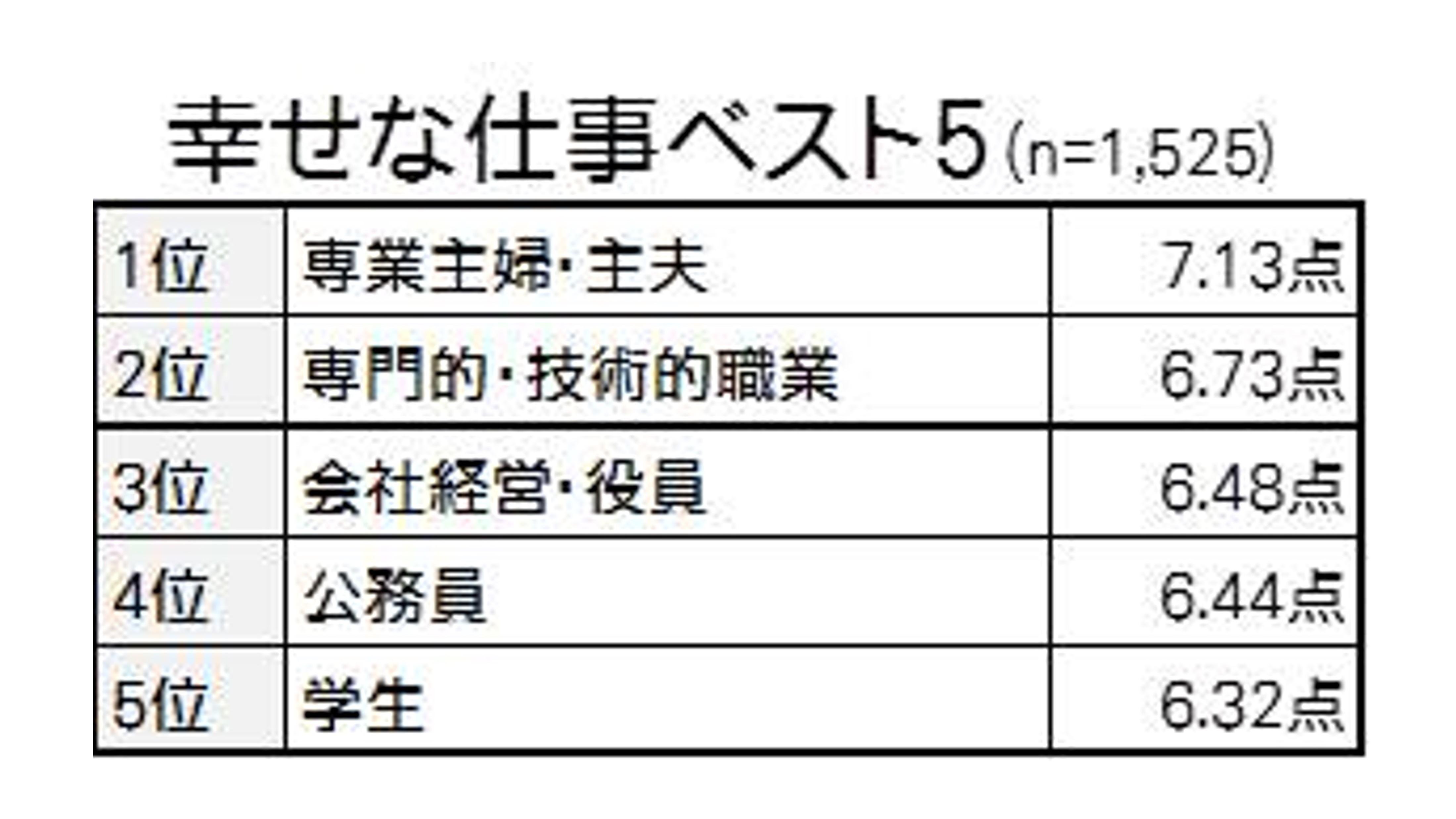
Looking at the average happiness scores by occupation, full-time housewives and househusbands came in first with a score of 7.13 points, significantly higher than the overall average happiness score of 6.20 points. In second place was "professional/technical occupations," which are considered to be "trade-related" occupations, with 6.73 points, followed by "company management/executive" with 6.48 points, "civil servant" with 6.44 points, and "student" with 6.32 points.
The top five hobbies that bring happiness are: 1st place "horticulture/gardening," 2nd place "knitting/crafts," 3rd place "cooking/gourmet food," 4th place "travel/sightseeing," and 5th place "jogging/walking."

When looking at the average happiness scores by hobby, the top spot went to those whose hobby is "horticulture/gardening" with 6.74 points, second place went to those whose hobby is "knitting/handicrafts" with 6.54 points, third place went to those whose hobby is "cooking/gourmet food" with 6.52 points, fourth place went to "travel/sightseeing" with 6.52 points, and fifth place went to "jogging/walking" with 6.42 points. It turns out that people whose hobbies require them to work on alone and concentrate on the activity tend to have relatively higher average happiness scores. Additionally, those who answered "Other (specify)" received a score of 7.04, and the more specific hobbies people had, the higher the average sense of happiness, with the main answers being "listening to music," "studying a language," and "calligraphy."Furthermore, those who answered "I don't have any hobbies" had the lowest average happiness score of 4.75 points.
Survey Overview
調査方法 インターネット (Tアンケート)
調査期間 2014年5月16日(金)~5月20日(火)
調査地域 全国
調査対象 18~79歳の男女 (T会員)
サンプル数 1,525名

| gender age | 10s to 20s | 30s to 40s | 50s to 70s | total |
|---|---|---|---|---|
| male | 201 people | 337 people | 203 people | 741 people |
| woman | 213 people | 360 people | 211 people | 784 people |
| total | 414 people | 697 people | 414 people | 1,525 people |
What is the T Survey?
This is one of the largest online research services in Japan, with 8 million T Card users registered. All members who complete research and surveys will be rewarded with T Points. In addition, the responses you provide will be processed as statistical information and used by companies and media outlets for product development and service planning. Each and every opinion we receive from our members will be an important key point in creating a bright future for people, companies, and Japan.
CCC offers marketing solutions to companies, from planning surveys through "T Surveys" to compiling and analyzing them as a research program tailored to their needs.
Materials related to this matter
"Survey on Happiness"Inquiries regarding this matter
Culture Convenience Club Co., Ltd.
Public Relations Officer: Ando TEL: 03-6800-4464
If you resonate with the content of this site, please feel free to share it.


