
Survey on working styles: 1,603 working people asked: 70% say they work less than 20 hours of overtime per month, and 10% currently have a side job
2017.02.15
Press Releases
Culture Convenience Club Co., Ltd.
-What do you want to do on Premium Friday? 1st place: "Relax at home," 2nd place: "Shopping," 3rd place: "Watching a movie"-
Culture Convenience Club Co., Ltd. is pleased to announce that it has conducted a "Survey on Working Styles" using the "T Survey," an online attitude survey, targeting 1,603 working men and women aged 18 to 69 who use T Cards.
Digest of the survey on working styles
●70% of employees work less than 20 hours of overtime each month. 20% said there is no overtime.
●70% of respondents said they would not introduce Premium Friday.
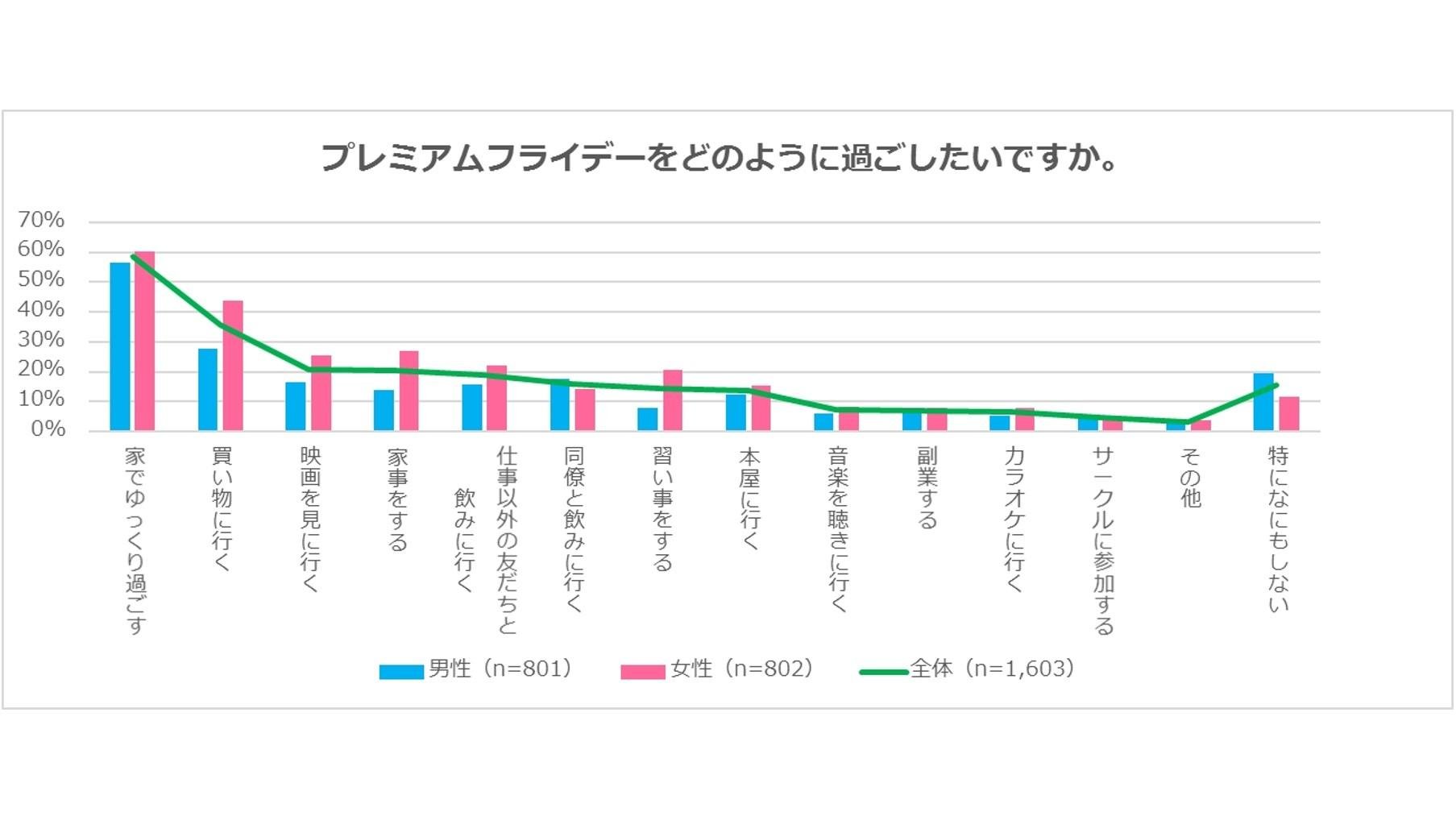
●Ranking of things to do on Premium Friday
1st place: "Relaxing at home", 2nd place: "Going shopping", 3rd place: "Going to the movies",
4th place: "Doing housework" 5th place: "Going out drinking with friends outside of work"
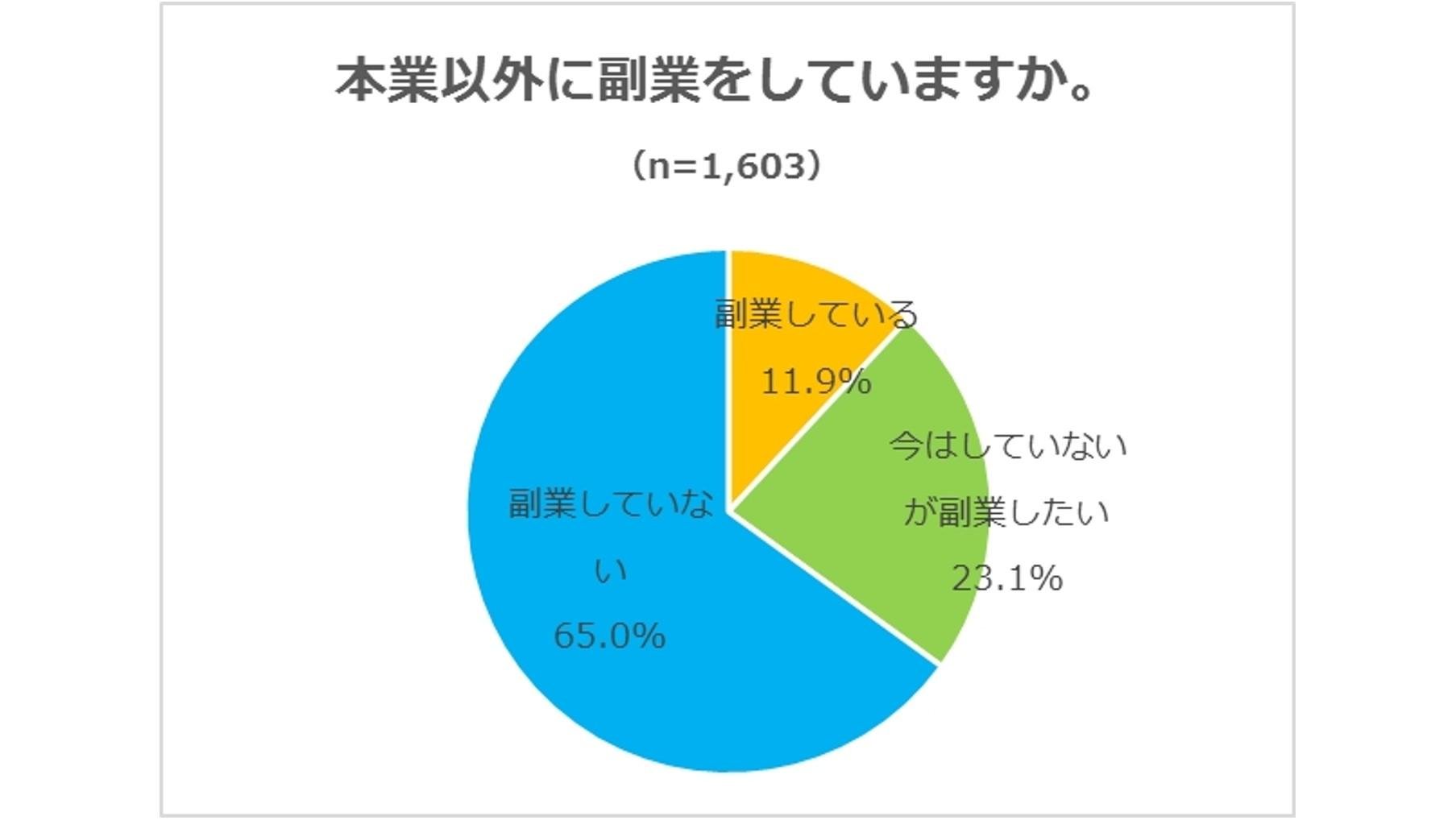
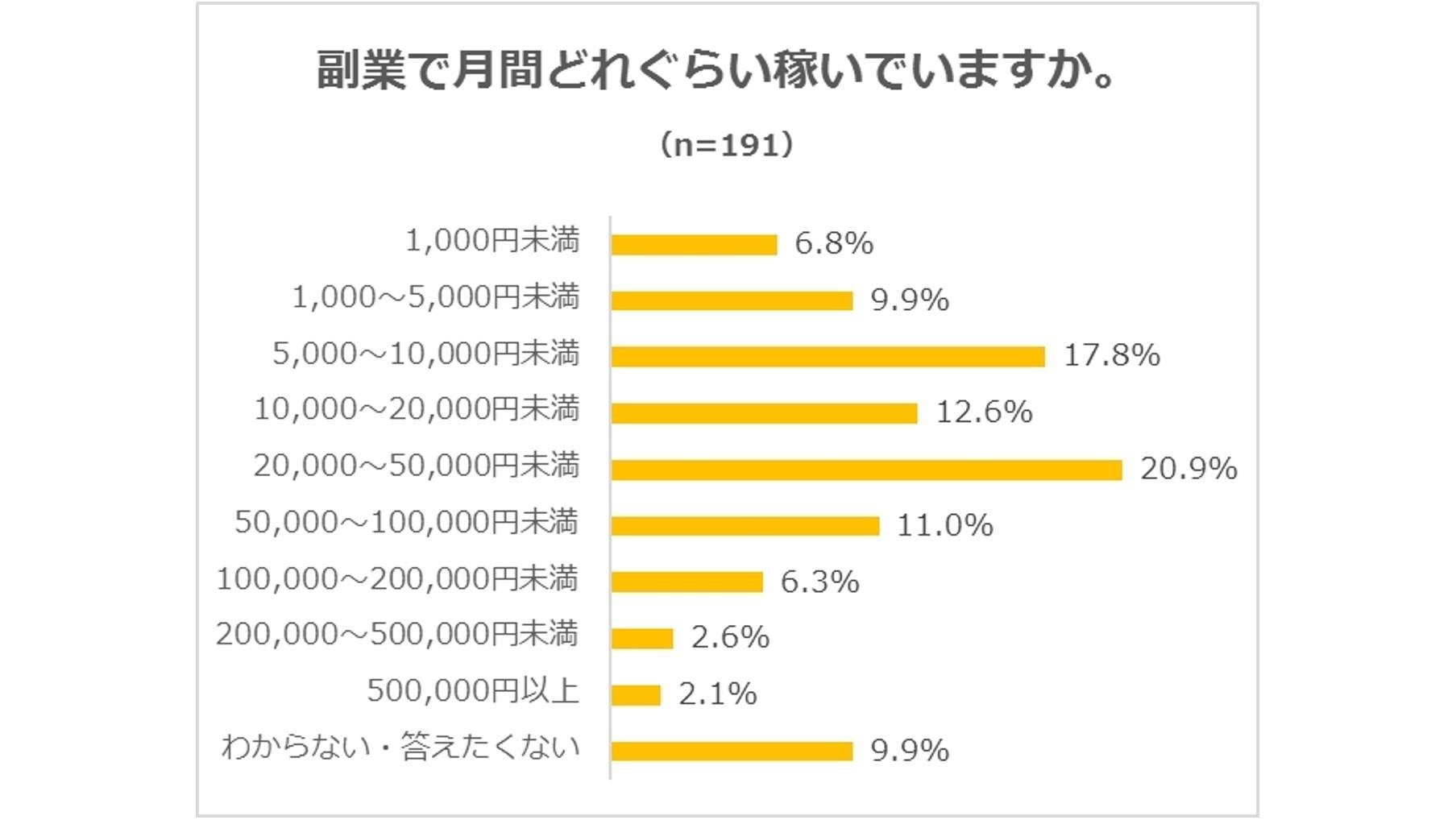
●10% of people currently have a side job. The most common amount earned was "20,000 to 50,000 yen per month."
●Ranking of things you want to do as a side job
1st place: "Points site/survey prize draw," 2nd place: "Homework/light work," 3rd place: "Finance/investment"
4th place: "Auction", 5th place: "Affiliate"
●What is your ideal workplace?
1st place: "Good interpersonal relationships," 2nd place: "Rewarding work," 3rd place: "High wages"
● What do you think about "Workstyle Reform" (free response)?
●70% of employees work less than 20 hours of overtime each month. 20% said there is no overtime.
In 2016, Prime Minister Abe proposed "realizing work style reform" as part of his goal of "realizing a society in which all 100 million people are active.""Workstyle Reform" is a project that will be tackled from the standpoint and perspective of workers in order to enable diverse working styles, increase the size of the middle class, avoid the entrenchment of disparities, and realize a virtuous cycle of growth and distribution. In response to the "Workstyle Reform," efforts are underway to bring about major changes in working styles, including overtime issues, Premium Friday, and the lifting of restrictions on side jobs. Therefore, in this T Survey, we conducted a "Survey on Working Styles" targeting 1,603 currently employed men and women aged 18 to 69.
First, we asked how many hours of overtime they work each month. The most common answer was "no overtime" at 24.9%, followed by "less than 5 hours" at 20.2%, "10 to 20 hours" at 14.3%, and "5 to 10 hours" at 11.4%. Overall, we found that 70% of respondents work less than 20 hours of overtime each month. Looking at the results by gender and age group, among men aged 18-29, the third most common answer was "30-40 hours" per month at 13.0%, while among those aged 50-69, 30.8% of men and 40.1% of women answered that they "do not work overtime," indicating that younger generations tend to work more overtime.

●70% of respondents said they would not introduce Premium Friday.
●Ranking of things to do on Premium Friday
1st place: "Relaxing at home", 2nd place: "Going shopping", 3rd place: "Going to the movies",
4th place: "Doing housework" 5th place: "Going out drinking with friends outside of work"
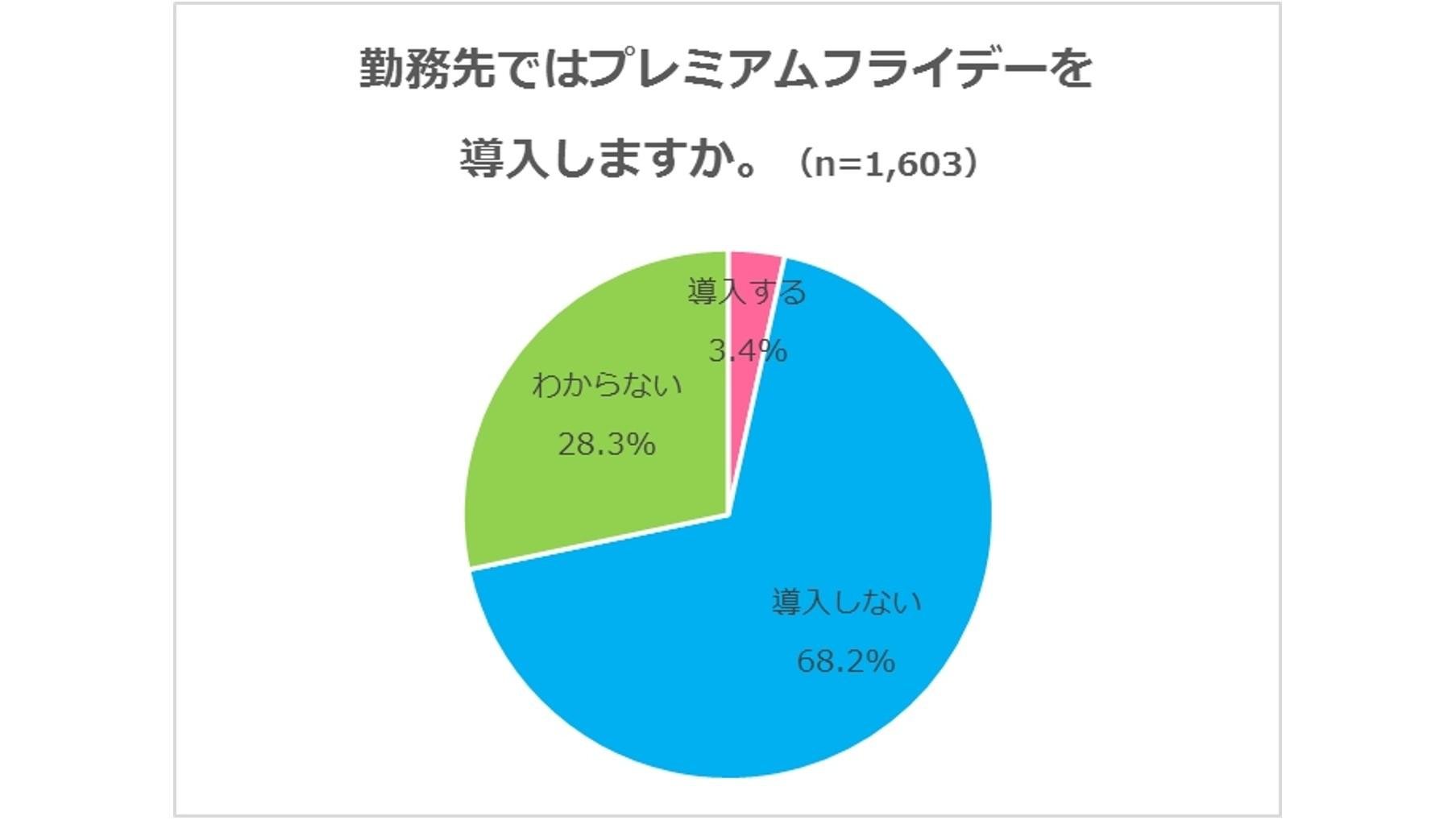
As part of the "Workstyle Reform," we asked about the status of Premium Friday, which will be implemented from Friday, February 24th, with the aim of "encouraging individuals to have experiences that make them feel happy and enjoyable (shopping, eating out with family, sightseeing, etc.) and creating time for these experiences."First, when asked whether their workplace would implement Premium Friday, 3.4% answered "yes," 68.2% answered "no," and 28.3% answered "don't know," revealing that there are still very few companies that will implement Premium Friday. Next, regardless of whether Premium Friday is introduced or not, respondents were asked to give multiple answers about how they would like to spend Premium Friday. The top answer was "relaxing at home" (58.5%), followed by "going shopping" (35.8%), "going to the movies" (20.8%), "doing housework" (20.3%), and "going out for drinks with friends outside of work" (19.0%). Half of respondents said they would stay at home and half would do activities outside. When looking at the results by gender, more women than men answered that they would "take up extracurricular activities," while more men than women answered that they would "do nothing in particular," showing that women are more enthusiastic about Premium Friday than men.
●10% of people currently have a side job. The most common amount earned was "20,000 to 50,000 yen per month."
●Ranking of things you want to do as a side job
1st place: "Points site/survey prize draw," 2nd place: "Homework/light work," 3rd place: "Finance/investment"
4th place: "Auction", 5th place: "Affiliate"
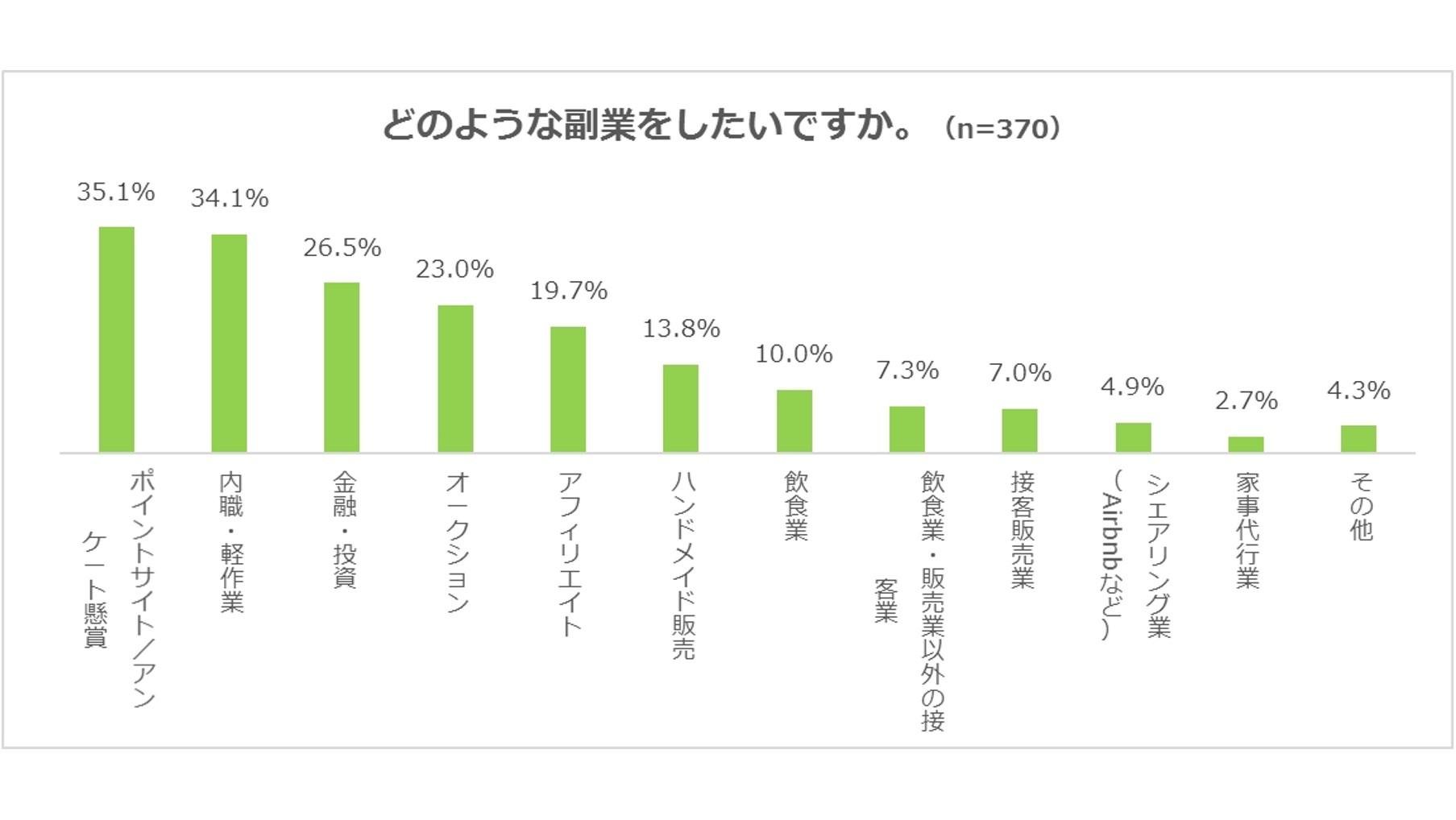
As part of the "work style reform," a movement has begun to change the policy of allowing full-time employees to have side jobs from "generally prohibited" to "generally permitted."When asked whether they had a side job, 11.9% answered "Yes, I have a side job," and 23.1% answered "I'm not currently working a side job, but I'd like to have one." This means that 10% of people overall have a side job, and if those who intend to have one are included, the figure rises to 30%. When those who answered "I have a side job" were asked how much they earn per month from it, the most common answer was "20,000 to less than 50,000 yen" at 20.9%, followed by "5,000 to less than 10,000 yen" at 17.8% and "10,000 to less than 20,000 yen" at 12.6%, and 10% of people overall earn more than 100,000 yen. Next, those who answered "I'm not doing it now, but I'd like to have a side job" were asked to select multiple answers to what kind of side job they would like to have. The top answer was "points sites/survey prize draws" (35.1%), followed by "homework/light work" (34.1%), "finance/investment" (26.5%), "auctions" (23.0%), and "affiliate marketing" (19.7%). This shows that if they were to have a side job, they tended to prefer a type of work that could be done easily from home, rather than working hard.
●What is your ideal workplace?
1st place: "Good interpersonal relationships," 2nd place: "Rewarding work," 3rd place: "High wages"
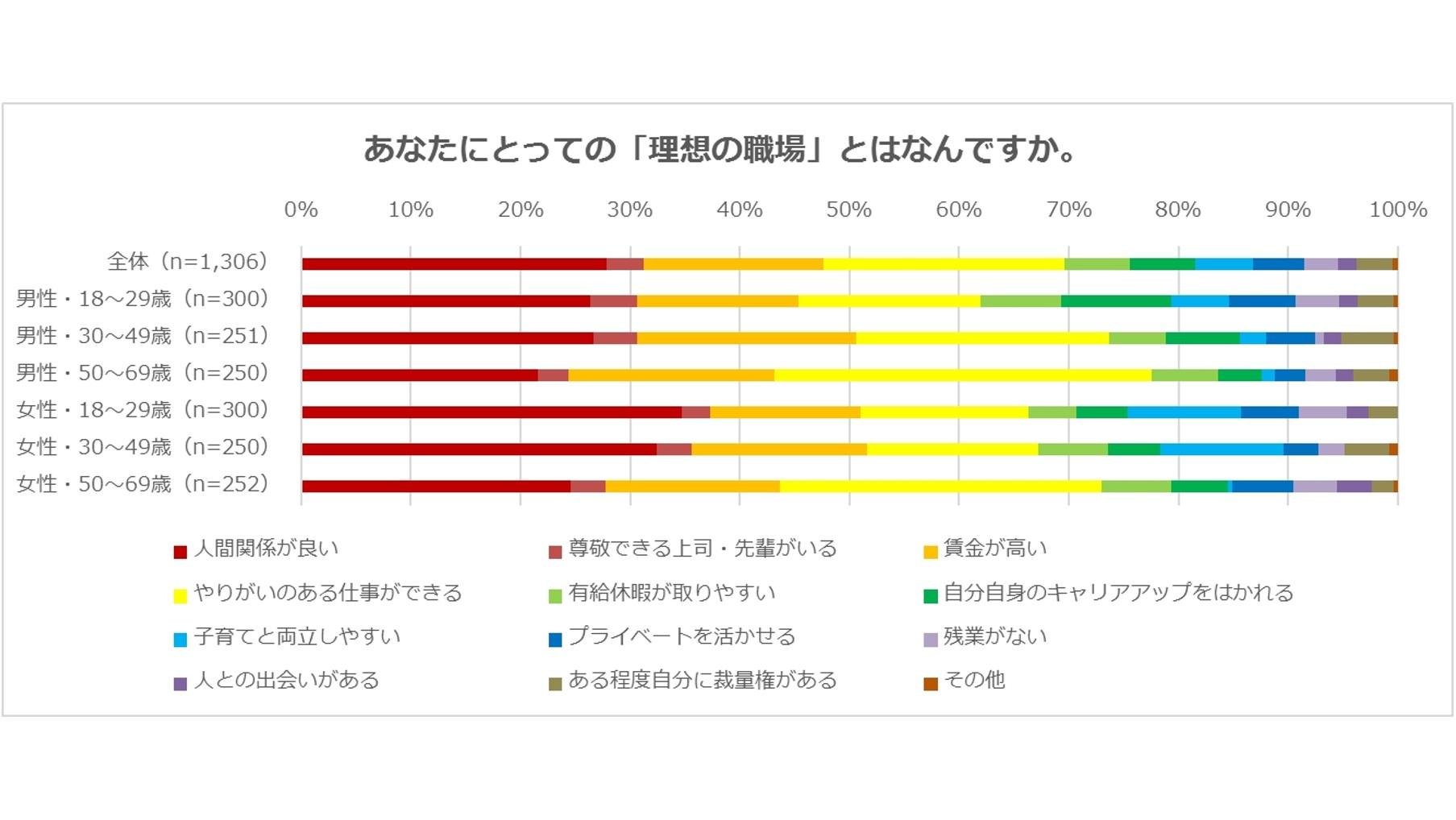
For working people, the workplace is the place where they spend most of their day. When asked what an ideal workplace would be to them, the top answer was "good interpersonal relationships" at 27.9%, followed by "rewarding work" at 22.0%, and finally "high wages" at 16.3%. Looking at the results by gender and age, for both men and women aged 50-69, the top answer was "being able to do a rewarding job."
As my career continued, I realized that the most important thing in work isn't money or people, but rather "satisfaction."Additionally, women aged 18-29 and 30-49 were more likely than others to say that it was "easy to balance work and child-rearing."
● What do you think about "Workstyle Reform" (free response)?
★With an eye on the aging population, we hope that the retirement age and working conditions after retirement will also be considered. (Chiba Prefecture/Male, 50s)
★This should definitely be introduced. In Japan, overtime work has become the norm, and I think private time is being neglected too much. (Kagoshima Prefecture/Woman in her 20s)
★If you don't set an ideal, you can't move on to the next step, so I think this is laying the foundation for changing your awareness even a little. (Shizuoka Prefecture/Woman in her 50s)
★I strongly support the idea of making diverse working styles possible. (Tokyo/Female, 50s)
★I think there will be some opposition, but I hope that reforms will be carried out without making easy compromises in order to improve the productivity of Japanese companies. (Kanagawa Prefecture/Male, 30s)
★I think it would be great to live in a society where everyone can work in a way that suits their lifestyle. (Miyazaki Prefecture/Woman in her 20s)
★I believe that promoting working from home and side jobs will lead to economic revitalization and increased motivation for individuals to work. (Aichi Prefecture/Woman in her 20s)
★I think there are many theoretical aspects to this, but nothing will change unless we start doing something, so I think this is a good way to get started. I hope that the spotlight will continue to be placed on working styles, and that better workplaces will be created for as many people as possible. (Tokyo/Male, 40s)
★It's easy to say, but I think it would be great to create a society where there are many ways of working that allow people to feel financially and mentally rich, so I agree with the idea itself. (Osaka Prefecture/Male, 40s)
★The productivity of Japanese workers depends on long working hours, so I would like to see the creation of working styles that enable them to achieve results without relying on long working hours. (Fukuoka Prefecture/Male, 40s)
★I would like you to promote this. I hope that we can break down the trend created by the baby boomer generation that says, "It's okay to do anything as long as it makes money."And I want you to create values that are different from what you have had until now. (Ehime Prefecture/Male, 50s)
★There are many people who feel that the current way of doing things has its limitations, and because these people have not yet reached the middle class, Japan's productivity and potential for development have declined significantly, so I think it would be a good idea to try and implement some kind of policy to break the current situation. People spend money when they have time, and spending helps keep the economy going, so I think it's worth trying. (Osaka Prefecture/Female, 40s)
★Women are also in need of economic power, so I think it is necessary to create an environment where they can choose how they work to suit that. (Iwate Prefecture/Woman in her 20s)
I think it is important to distinguish and eliminate disparities, but I think it would be extremely difficult to address individual motivation and ability (Tokushima Prefecture/Male, 50s)
★No matter how much the government tries to implement policies, I don't think it will be meaningful unless companies change their working environment or wages. (Tokyo/Female, 20s)
★I predict that this will be nothing more than a perfunctory slogan and will either be completely ineffective or will only make the situation worse. I believe that if the government intervenes more than necessary in issues such as these, nothing good will come of it, just as it did in the past, leading to an explosive increase in non-regular employment and prolonged stagnation of the Japanese economy. (Kanagawa Prefecture/Male, 50s)
★A perfect example of mochi. If we really want to do this, we need full government backing, but Japan currently lacks the power and money to do so. There's no need to say fancy things about work style reform, I just want them to show us a secure future if we just work hard. Employment today is unstable in every industry, and people are unable to risk their lives to work for their company, society, or country. It is a society enveloped in fear born of anxiety. (Hyogo Prefecture, male, 30s)
★It can be said that the Japan we know today is the result of the working style that Japan has cultivated since ancient times. However, I am concerned that the system will move forward and we will end up working in the gap between reality and the law. (Aichi Prefecture/Male, 20s)
★I think it's a very good initiative, but in the end, such initiatives don't trickle down to rural areas. Unless it has a stronger effect, it will always remain something that doesn't concern me. (Ehime Prefecture/Male, 20s)
★Reform cannot be achieved even if the government promotes it. We should start by changing the mindset of those currently in management positions. (Chiba Prefecture/Woman in her 40s)
★No matter what kind of work style people choose, there must be industries and jobs (services, transportation, retail, etc.) that support them. While there are people who can enjoy their days off as holidays, there are also people who can no longer take time off, so I think the gap will not disappear but will get worse, and reform will be impossible. (Hyogo Prefecture, male, 40s)
★I think the general framework is good, but I think it will be difficult to adapt to the manufacturing industry. (Hiroshima Prefecture, male, 30s)
★I think it's a good attempt, but it's not realistic, and I don't think anything will change in the end. (Tottori Prefecture/Woman, 30s)
★Instead of concentrating work in one place, I would like to see more jobs created in rural areas and a system established that makes it easier for people to take paid leave and work, not only in large companies but also in small and medium-sized enterprises. In addition, construction periods in the construction industry are determined by budgetary considerations, including the process and number of working days, but unless construction periods are not set so that they are not tied to the end of the fiscal year, I don't think it will lead to improvements in the working environment for craftsmen. (Ishikawa Prefecture, male, 60s)
★Many small and medium-sized enterprises are operating with the bare minimum number of employees and salaries, so I think that reform will be meaningless unless it first eliminates the disparity in salaries and working hours between large and small companies. (Yamagata Prefecture/Woman in her 40s)
■ Survey Overview
Survey method: Internet (T Survey)
Survey period: February 3rd (Friday) to February 8th (Wednesday), 2017
Survey area: Nationwide
Survey subjects: Working men and women aged 18-69 (T members)
Number of samples:
18~29歳 30~49歳 50~69歳 合計
男性 300人 251人 250人 801人
女性 300人 250人 252人 802人
合計 600人 501人 502人 1603人
■What is the T Survey?
This is one of the largest online research services in Japan, with 12 million T Card users registered. All members who complete research and surveys will be rewarded with T Points. In addition, the responses you provide will be processed as statistical information and used by companies and media outlets for product development and service planning. Each and every opinion we receive from our members will be an important key point in creating a bright future for people, companies, and Japan.
CCC offers marketing solutions to companies, from planning surveys through "T Surveys" to compiling and analyzing them as a research program tailored to their needs.
Materials related to this matter
Survey on working styles: 1,603 working people asked: 70% say they work less than 20 hours of overtime per month, and 10% currently have a side job
Inquiries regarding this matter
Culture Convenience Club Co., Ltd.
Public Relations: Ando
TEL: 03-6800-4464
If you resonate with the content of this site, please feel free to share it.


