
T Card's social value creation project "T Card Everyone's Social Project" will start selling "Goto Fish Ham" made from unused fish from November 13th
2019.11.13
Press Releases
T Point Japan Co., Ltd.
- "T Card Data x T Member Network x Goto Fish" Aiming to contribute to sustainable fishing and help revitalize the Goto region -
T Point Japan Co., Ltd. (Headquarters: Shibuya-ku, Tokyo; President and COO: Kitamura Kazuhiko; hereinafter referred to as "T Point Japan") is implementing the "T Card Everyone's Social Project," a social value creation project that utilizes over 69 million T members, 194 T Point Alliance companies, and approximately 5 billion pieces of purchasing data provided by the T Card to give back to and contribute to society and consumers.
In June 2018, as the third installment of the "T Card Everyone's Social Project," the "Goto Fish Project" () was launched, which involves producing delicious local produce with the T Card in collaboration with primary producers. https://tsite.jp/r/tcardsocial/goto/) was launched. The Goto Fish Project is a product development project that aims to establish a sustainable "sixth-generation industrialization" by utilizing T Card data and the T Member network to create added value for Goto fish and provide it as a product that will please consumers. Through this project, we have created "Goto Fish Ham," which utilizes "unused fish" that are not distributed due to their value for various reasons, such as irregular sizes, minor fish species, or small batches, and we are pleased to announce that it will go on sale from November 13, 2019.
■Unused fish in Goto
The Goto Islands are home to a wide variety of fish, thanks to the warm Tsushima Current, which branches off from the Kuroshio Current, one of the world's largest ocean currents, in southwest Kyushu and flows into Tsushima. The Goto Islands are blessed with an abundance of fish, but there are many species that are difficult to distribute to urban areas due to transportation issues such as maintaining freshness and costs. Specifically, fish species such as rabbitfish, parrotfish, and red snapper that are caught in fixed nets are known as unused fish. These fish grow mainly on seaweed, giving them a distinctive seashore scent, and ingenuity is required to distribute them widely. Furthermore, if the number of fish that eat seaweed increases too much, it will become difficult for sea urchins and other animals that also feed on seaweed to survive, resulting in problems such as the inability to secure spawning grounds for fish. Furthermore, if seaweed communities die due to predation, a condition known as "rocky shore bleaching," there is a risk that water quality will deteriorate rapidly. T Point Japan has grasped the needs and challenges of fisheries-related parties such as fishermen, fishing cooperatives, and seafood processing companies, and has worked to develop products using unused fish from Goto, based on the idea that assigning a certain value to unused fish caught in nets and using them may lead to sustainable fishing in order to protect Goto's fish and clean ocean.
In developing the product, we enlisted the participation of 12 T-Card members who "love seafood and are particular about food" as consumer representatives, selected from over 69 million people based on various lifestyle data from T-Card*; Hamaguchi Suisan Co., Ltd., a seafood processing company in Goto, as producer representatives; Maruetsu Inc., a supermarket chain that operates Maruetsu, Maruetsu Petit, and Lincos as distributor representatives; chef Morieda Miki, who considers and promotes food sustainability; Goto City; and Tsutsuuraura Co., Ltd., an affiliate of the Agriculture, Forestry and Fisheries Innovation Corporation of Japan, which supports the sixth-generation transformation of primary industries. By connecting the knowledge of stakeholders from different fields and positions, we attempted to solve the issue of unused fish that Goto is facing.
*Data is derived in a way that does not identify individual customers, such as names or addresses.
■ Steps leading up to product creation
During the product development process, we provided stakeholders with the opportunity to access T-Card data, incorporated elements derived from the data into the planning, and proceeded in the following steps.
(1) September 2018: "Concept Ideation" - Fieldwork to Discover the Charms of Goto
Twelve T members visited Fukue Island, experienced fixed net fishing in the waters off Goto, and learned about the attractions of Goto and the challenges facing the fishing industry through fieldwork.Based on this experience, they held a session with students from Goto High School to broaden their concept ideas using purchasing data on fresh fish and products containing fish as an ingredient, and to exchange product ideas.
(2) November 2018 to July 2019: "Prototype Creation," "Product Story," and "Prototype Creation" - Product Development Sessions
Members from T, Maruetsu, Hamaguchi Suisan, and Morieda shared their knowledge and ideas with each other, comparing the product ideas derived in the September session with data on the customer characteristics of the distributors based on their opinions, to explore the direction of the product and create a prototype. Afterwards, a session was held in which each stakeholder dug deeper into the product prototype and narrowed down the product's direction to one. We then repeatedly hypothesized and tested the product based on assumed consumption scenarios and data related to those consumption scenarios, set the target customer demographic, and analyzed the preferences of the target customer demographic from the data to create a "product story" and "prototype."
(3) February to October 2019: “Commercialization”
Based on the prototypes created during the product development sessions, Hamaguchi Suisan, Morieda, and Maruetsu Inc. worked together to derive the purchasing characteristics of the target customer group from data and created a recipe for commercialization. They also set the price and created the packaging based on data such as the design desired by the target customer group.
(4) November 2019: Product release and availability at restaurants
The product will be sold at Maruetsu, Kodawariya, Kotobuki Shoten, and Hamaguchi Suisan, and will also be served at Yanaka Beer Hall. We plan to gradually expand the number of stores that carry our products in the future.
Through this initiative, T Point Japan hopes to address the challenges facing Japan's primary producers through "sixth-generation industrialization," and that this product will help people learn about the wonderful fish of Goto and encourage them to visit the island. We also hope that utilizing unused fish will contribute to sustainable fishing, help revitalize the Goto region, and contribute to achieving the SDGs.
Going forward, we will continue to strive to create new social value, with the aim of T Card being a platform that "connects people and society."
<"Goto Fish Ham" Product Overview>
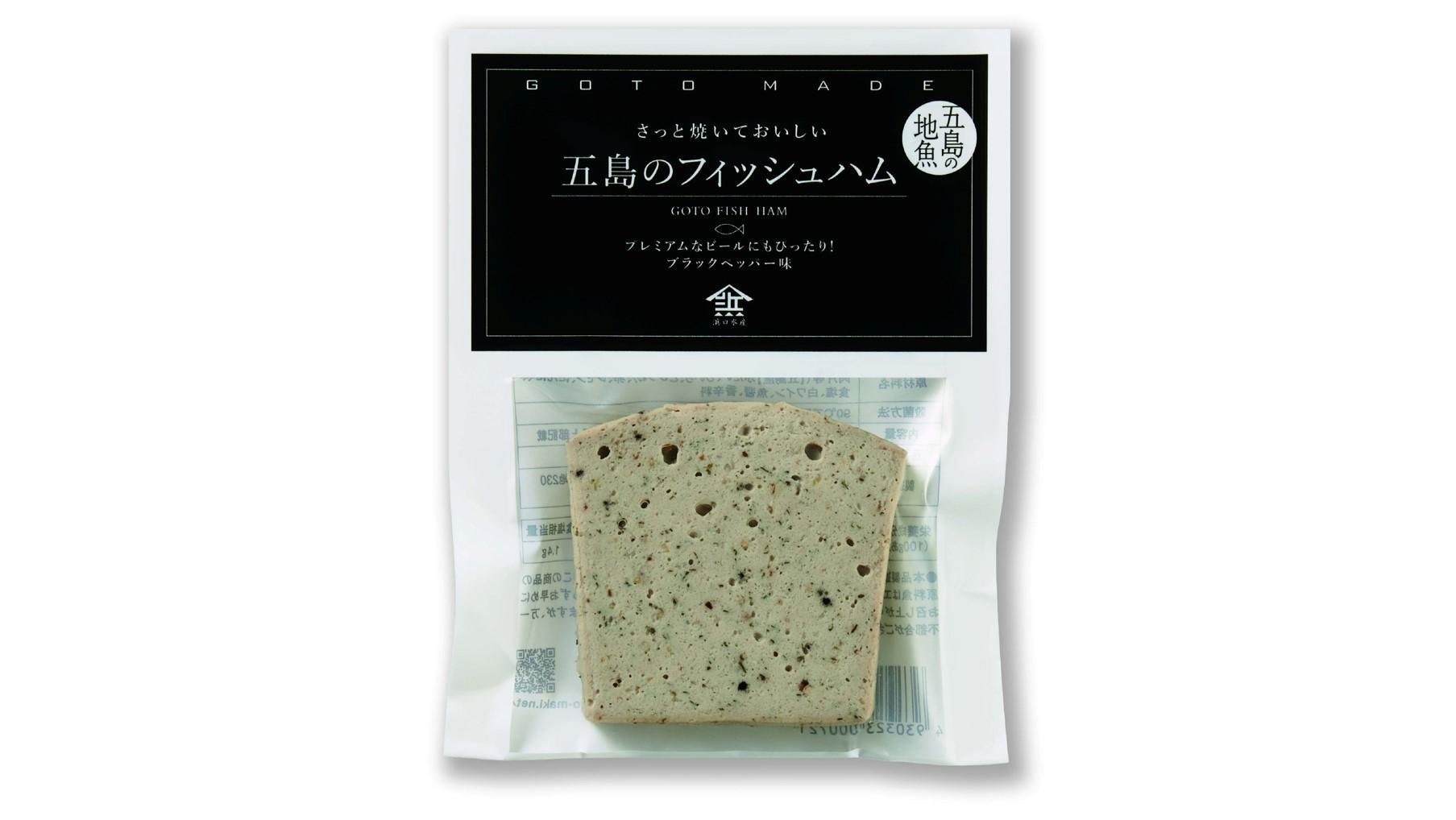
This product is made from 100% local fish from Goto, and has a new texture and a delicious taste that pairs well with beer. We used unused fish to create the firm texture of ham, and added black pepper, herbs, and salted lemon. When you think of fish ham, you might think of fish cakes or kamaboko, which are also seafood products, but the taste is completely different. To give an example, it tastes like thickly sliced bologna sausage. Simply take it out of the bag and quickly fry it in olive oil to create a dish that goes perfectly with beer.
Ingredients: grape daikon, whitebait, flying fish, egg, lemon, garlic, salt, white wine, fish sauce, spices
■Contents: 65g per sheet
■ Best before date: 60 days
■Storage method: Keep refrigerated (below 10°C)
Nutritional information (per 100g): Calories 94kcal, Protein 16.1g, Fat 1.1g, Carbohydrates 4.8g, Salt equivalent 1.4g
■ Manufacturer's suggested retail price: 300 yen (excluding tax)
■Features:
(1) A new texture that has never been seen before, without using starch
Without using any starch as a binder, we have achieved a new texture that is different from both satsumaage and kamaboko.
(2) No additives, chemical seasonings, or sugar added
No coloring agents, preservatives, chemical seasonings, or sugar are added. It is low in fat, sugar, calories and high in protein.
(3) Most of the ingredients are from Goto
All ingredients are domestically produced except for the white wine and spices. Furthermore, most of the domestic ingredients are produced in Goto, with only the lemons in the salted lemons and eggs coming from outside the island. Hamaguchi Suisan, the manufacturer of this product, makes its own salted lemons every year using lemons from the island, but as this was not originally done for product development purposes, the current product uses domestic lemons from outside the island. In addition to the fish, the restaurant is also particular about using all Goto ingredients, including garlic, salt, and fish sauce.
■Stores that carry this product:
・65 Maruetsu stores
・45 "Kodawariya" stores (Sales will start from November 18th. )
*For details on Maruetsu and Kodawariya stores, click here
・"Kotobuki Shoten" online store:https://www.rakuten.ne.jp/gold/sakanaya/
・"Hamaguchi Suisan" 4 stores, online store:https://www.goto-maki.net/
・Nagasaki Products Center (2nd floor of Prefectural Bus Terminal, 3-1 Daikoku-cho, Nagasaki City, Nagasaki Prefecture)
・Nagasaki Hamaya (7-11 Hamamachi, Nagasaki City, Nagasaki Prefecture)
■Restaurants offering the product:
・"Yanaka Beer Hall"https://uenosakuragiatari.jp/shop_space/(Ueno Sakuragi Atari Building 1, 2-15-6 Ueno Sakuragi, Taito-ku, Tokyo)
[About Hamaguchi Suisan]https://www.goto-maki.net/
Taking advantage of the location, surrounded by the sea and blessed with abundant fishing resources, the company has been making fish paste products using fresh ingredients for over 80 years. "Handmade in the old-fashioned way" and "bringing out the full natural flavor of the fish" - our origins lie in the taste of the fish paste that was handmade in each household in the past, and the original deliciousness that retains the natural flavor of each type of fish. Hamaguchi Suisan is a company based in the Goto Islands in Nagasaki Prefecture, and we continue to produce kamaboko in close contact with our customers, fish, vegetables, and the Goto Islands, so that people who live on the islands, people who have left the islands, and people who are unfamiliar with the islands will all think of Goto as a delicacy.
[About Mr. Miki Morieda]
After graduating from a vocational school, he trained at "Tetsuya's" in Sydney, "Kozuki" in Omotesando, and "tapas molecular bar" at the Mandarin Oriental Tokyo. He then went independent within 246common in Omotesando, and within six months he was running and operating three stores within the facility. Two years later, after working as a chef at Salmon & Trout in Daizawa, he founded eat creator Inc., where he is involved in food production in general. The stores he has been involved in producing include "The OPEN BOOK" in Shinjuku Golden Gai, "Maruta" in Chofu, and "Sabananano." in Omori. ", "UB1 TABLE" in Aoyama, "Revive Kitchen THREE AOYAMA" in Aoyama, and "chompoo", the main dining restaurant at Shibuya Parco. He also launched the food media "RiCE," served as food director for "The Food Film Festival Tokyo," and was the lead chef for "Chefs for the Blue." He is also active in a variety of media, including television, radio, and magazines.
[About the Sustainable Development Goals (SDGs)]
The Sustainable Development Goals (SDGs) are international goals for the period from 2016 to 2030 that were set out in the 2030 Agenda for Sustainable Development, which was adopted at the United Nations Summit in September 2015 as the successor to the Millennium Development Goals (MDGs) formulated in 2001. It consists of 17 goals and 169 targets to achieve a sustainable world, and pledges to leave no one behind on the planet. The SDGs are universal goals that not only developing countries but developed countries themselves should work towards.
The Goto Fish Project aims to achieve the following five goals:
Goal 8: Decent work and economic growth
Goal 9: Industry, innovation and infrastructure
Goal 12: Responsible Consumption and Production
Goal 14: Life below water
Goal 17: Partnerships for the goals
[First step: Developing a new product using T-Card's big data and Sanriku oysters]
Project site:https://tsite.jp/r/tcardsocial/oyster/
In November 2016, we began a project to develop products using Sanriku oysters as an ingredient, based on T-Card data. Based on various lifestyle data from T Card, we selected 550,000 T members from the more than 60 million T members who are seafood lovers and have a strong preference for food, and asked them to support the project. Of these, nine T members participated, and together they worked to develop products using Sanriku oysters. Then, on October 5, 2017, we began selling our new products: "Large Fried Oysters with Curry and Garlic Flavor" and "Large Fried Oysters with Parsley and Cheese Flavor," as well as basil-flavored oysters "Oysters and Basil in Oil."
[Second installment: "Reborn-Art Festival x T Card"]
Project site:https://tsite.jp/r/tcardsocial/art/
In June 2017, we launched the "Reborn-Art Festival x T Card" initiative as an initiative to connect the future of children with the local community. The Reborn-Art Festival is a new festival held mainly in the Ishinomaki and Oshika areas where you can enjoy art, music, and food. The "Reborn-Art Festival x T Card" is an art and music festival that allows both adults and children to participate, with children taking the lead in creating artworks that are rooted in the local community and will serve as a source of regional revitalization for the future. As part of this project's utilization of the T-Card infrastructure, social contribution T-Cards were issued, and part of the card issuance fees and half of the T-Points earned by using the card were used to support the art projects that the children were working on.
Materials related to this matter
T Card's social value creation project "T Card Everyone's Social Project" will start selling "Goto Fish Ham" made from unused fish from November 13th
Inquiries regarding this matter
T Point Japan Co., Ltd.
Public Relations: Ando
TEL: 03-6800-4464
If you resonate with the content of this site, please feel free to share it.


