
Social project "School General Election" connects junior and senior high school students with politics and society, conducting questionnaire survey on "elections"
2020.07.03
Press Releases
CCC Marketing Co., Ltd.
- High school students' voting intentions rival those of adults? 60% say, "If there is an election, I will definitely vote" -
CCC Marketing Co., Ltd. (Head office: Shibuya-ku, Tokyo; CEO: Kazuhiko Kitamura) is working on a social project called "School General Election" to connect the junior and senior high school generation, who will be responsible for the future, with politics and society. Ahead of the Tokyo gubernatorial election to be held on July 5, 2020, we conducted a questionnaire survey on "elections" through the online survey "T Survey," targeting 3,119 men and women nationwide, ranging in age from high school students to 89 years old.
Topics: Survey on "Elections"
1. High school students' voting intentions rival those of adults? 60% say, "If there is an election, I will definitely vote."
Among those in their 60s and older, 80% said they would "always vote," while the lowest was 50% among those in their 30s.
2. The most common reason why high school students vote is to "make the world a better place" - a pure and straightforward reason.
Among those in their teens and twenties, the most common feeling is, "If there is an election, I have to vote."
3. The reason why 30% of people in their teens and twenties don't vote is because they're "too busy to find time to vote."
In general, people tend not to vote because they believe "the world will not change whether I vote or not."
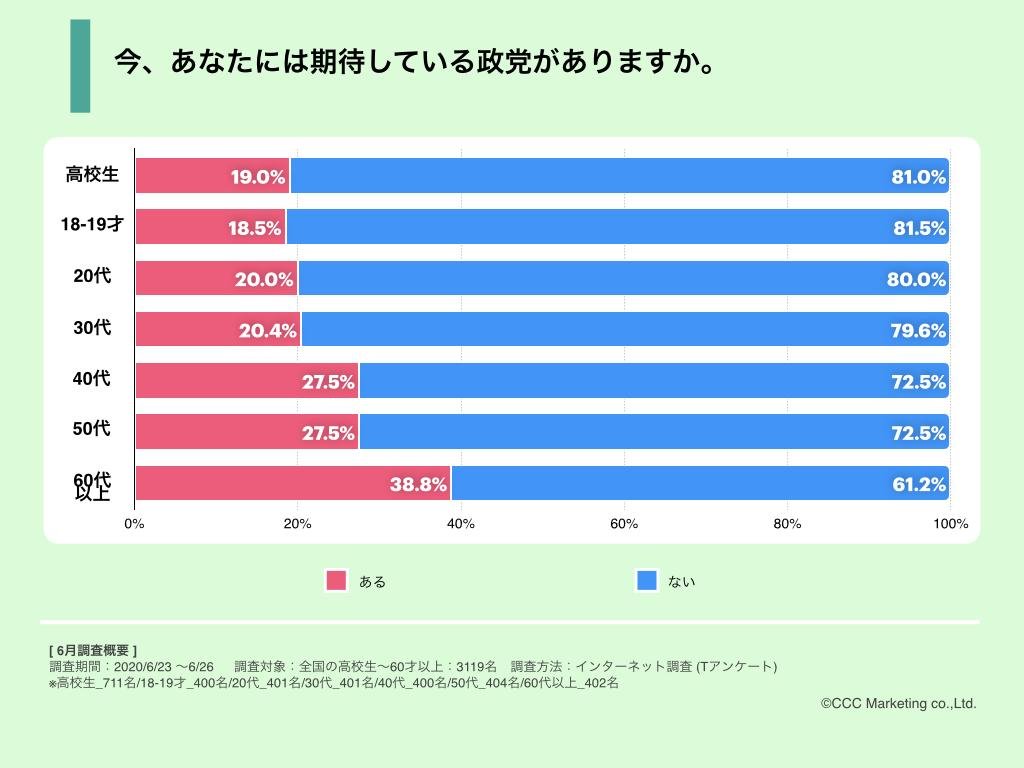
4. 80% of young people, including high school students, believe that "Internet voting should be introduced" and "there is no political party they have high hopes for."
■ Survey Overview
Survey method: Internet (T Survey)
Survey period: June 23rd (Tuesday) to June 26th (Friday), 2020
Survey area: Nationwide
Survey subjects: Men and women aged 15 to 89 (T members)
Sample size: 3,119 people
Survey results: Questionnaire survey on "elections"
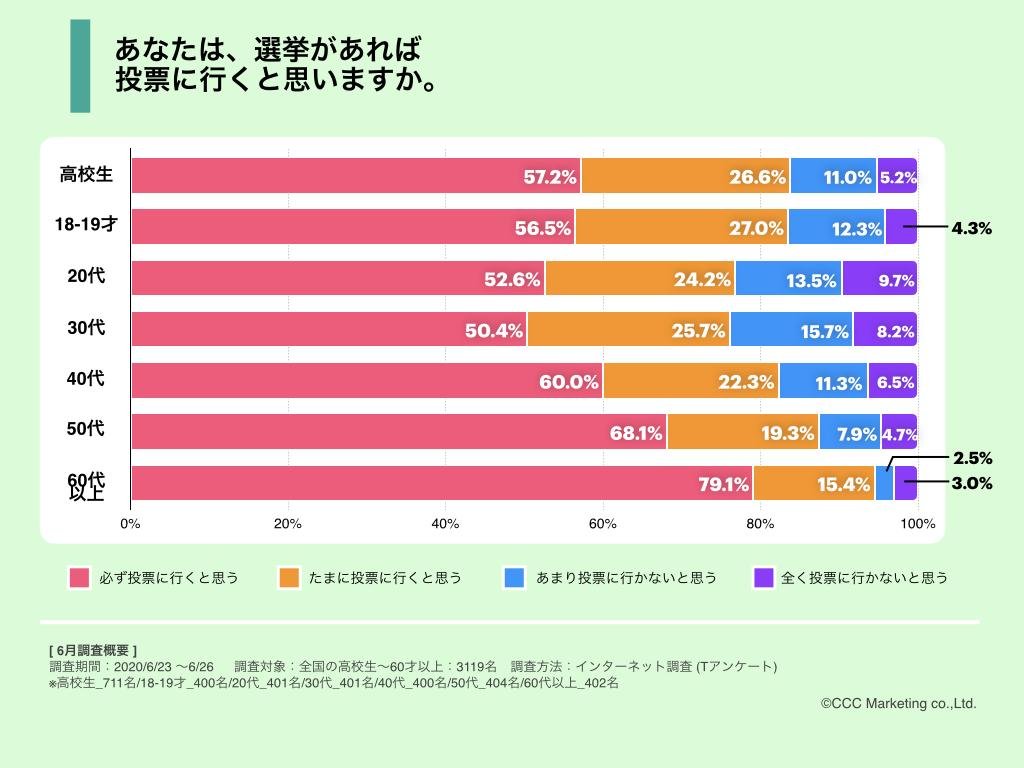
1. High school students' voting intentions rival those of adults? 60% say, "If there is an election, I will definitely vote."
Among those in their 60s and older, 80% said they would "always vote," while the lowest was 50% among those in their 30s.
Ahead of the Tokyo gubernatorial election on July 5th, we asked citizens across the country, including high school students, whether they would vote if there was an election. 57.2% of high school students answered, "I would definitely vote."
On the other hand, among those aged 18 and over who have the right to vote, the highest intention to vote was among those in their 60s and over at 79.1%, and the lowest was among those in their 30s at 50.4%.
Even when combining those who "will definitely vote" and those who "will occasionally vote," we found that the intention to vote among high school students who do not have the right to vote is second only to seniors.
2. The most common reason why high school students vote is to "make the world a better place" - a pure and straightforward reason.
Among those in their teens and twenties, the most common feeling is, "If there is an election, I have to vote."
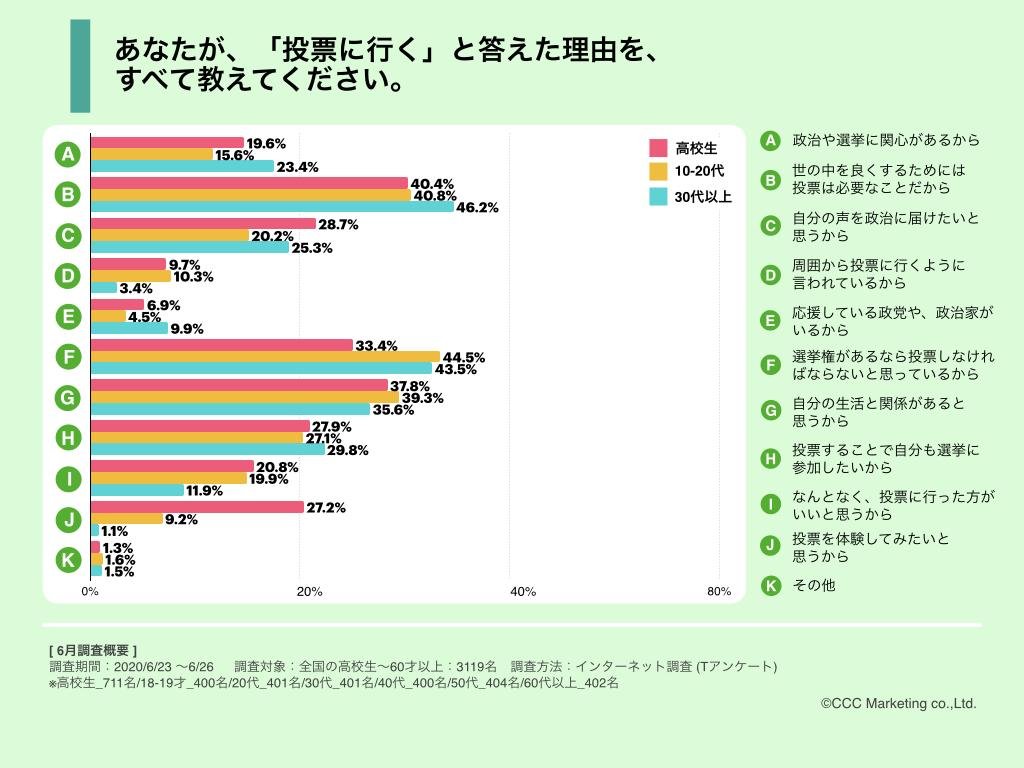
When asked why they would vote, the most common answer from high school students was "Because voting is necessary to make the world a better place," at 40.4%, a pure and straightforward reason.
This answer was also chosen by many people outside of high school age, demonstrating the sincerity with which Japanese people feel about voting. Also, the big difference between high school students and other age groups was due to a reason unique to high school students: "I want to experience voting."
On the other hand, the most common answer among those in their teens and twenties was "Because I believe I have to vote if there is an election," at 44.5%, indicating that they view voting as a sense of mission.
3. The reason why 30% of people in their teens and twenties don't vote is because they're "too busy to find time to vote."
In general, people tend not to vote because they believe "the world will not change whether I vote or not."
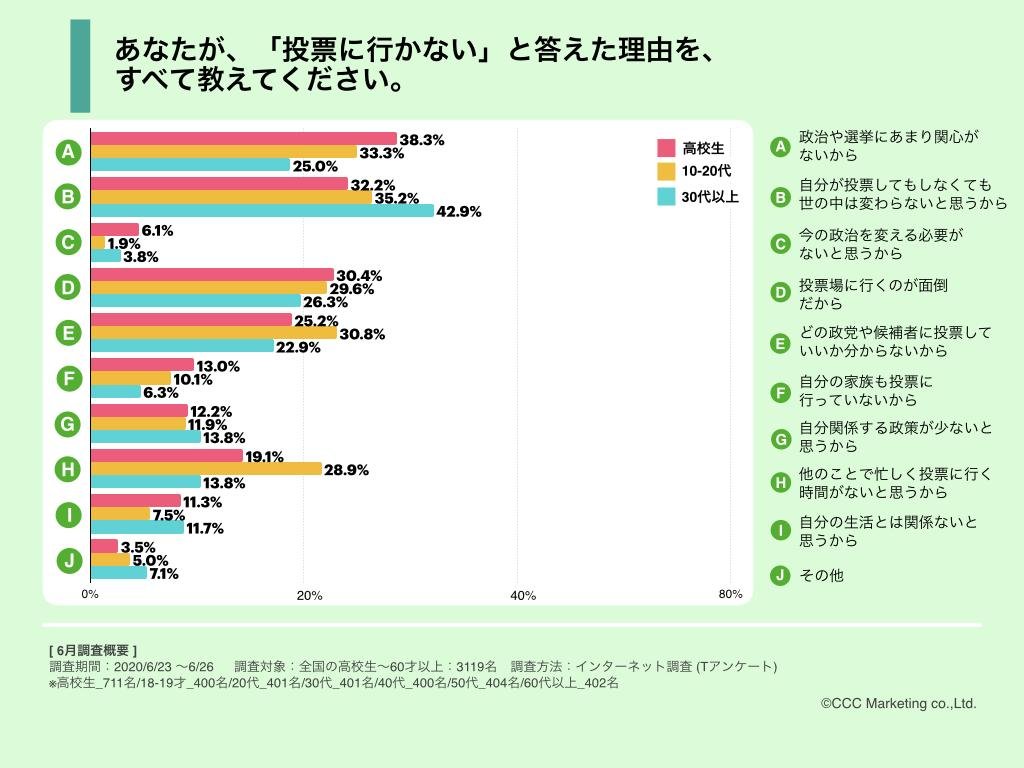
When asked why they would not vote, the most common answer given by high school students was "Because I'm not very interested in politics or elections," at 38.3%. The most common reason given by people in their teens and twenties and those in their thirties and older as to why they don't vote is, "I don't think the world will change whether I vote or not."
This reason was chosen by 35.2% of those in their teens and twenties and 42.9% of those in their 30s and older, indicating a strong sense of resignation. It is extremely important to make people realize that voting can change society, and it is clear that there is a major challenge ahead.
Additionally, the reason given by those in their teens and twenties, who were by far the most likely to vote compared to other generations, was "Because I'm too busy with other things and don't think I have time to vote."These responses show that in an era where there is fierce competition for disposable time, efforts are needed to encourage young people to vote.
4. 80% of young people, including high school students, believe that "Internet voting should be introduced" and "there is no political party they have high hopes for."
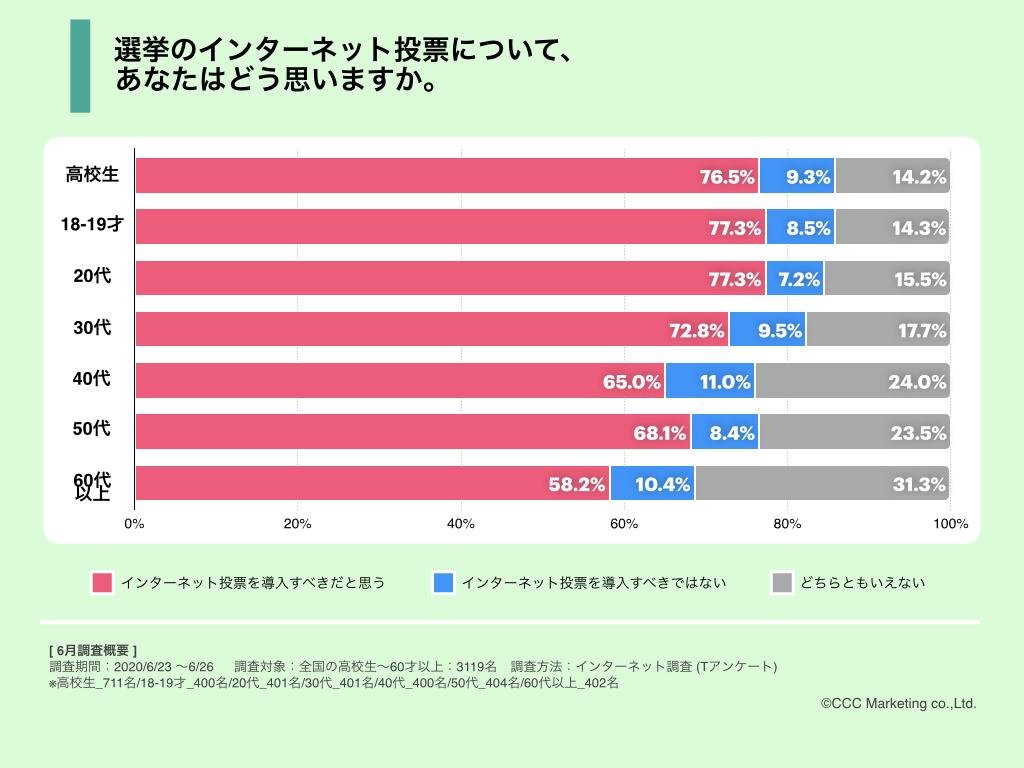
Internet voting has been introduced in Estonia, a country famous for being an electronic nation. Recently, internet voting has been gaining attention as a way to increase voter turnout. When asked what they thought about internet voting in elections, 80% of high school students, 19-19 year olds, and young people in their 20s answered that they "think internet voting should be introduced."
Additionally, 70% of people in their 30s and 60% of people in their 40s and older are highly interested in adopting internet voting, and although there are several issues to be addressed, such as security, future trends in internet voting are likely to attract attention.
When asked whether there was a political party they had high hopes for, only 20% of people from high school students to those in their 30s answered "yes."
Furthermore, 60-70% of people in their 40s and older responded that they do not have a preferred political party, indicating that there is a need to increase interest in politics and voting among all generations, including younger generations.
"School General Election" Service Overview
■Project name: School General Election
■Project start date: June 16, 2020 *Full-scale launch is scheduled for this fall
■Project content: Aimed at junior and senior high school students, we will raise themes related to issues affecting the future generation of young people from a wide range of areas, from politics and social issues to further education and school, and provide neutral information on the issues raised and a space for people of the same generation to deepen dialogue. By actually "voting" on the website and Twitter, we will create an opportunity for each junior and senior high school student to actively participate and express their opinions. We also plan to publish articles on note reporting on the voting results that compile the "voices" of junior and senior high school students, as well as interviews with experts, and provide a forum for planning and holding dialogue with opinion leaders.
■Twitter account: School General Election Project [Official] @T_gakkou
■Note account: School General Election Project [Official]
Future topics to be covered include: "Young people's voting rate," "Social issues of concern," "Online voting," "Postponement of university entrance exams," and "Optional separate surnames for married couples."
Materials related to this matter
Social project "School General Election" connects junior and senior high school students with politics and society, conducting questionnaire survey on "elections"
Inquiries regarding this matter
CCC Marketing Co., Ltd.
Public Relations Officer: Ando/Nonaka / TEL: 03-6800-4464
If you resonate with the content of this site, please feel free to share it.


