
[Final results announced] Young people's preferred political party is the Liberal Democratic Party (60%) and the Constitutional Democratic Party (CDP) (10%). They tend to gather information independently and vote based on a comprehensive judgment.
2021.11.10
Press Releases
CCC Marketing Co., Ltd. / T Point Japan Co., Ltd.
- "School General Election Project" connects junior and senior high school students and those in their 20s with politics and society -
CCC Marketing Co., Ltd. (Head office: Shibuya-ku, Tokyo; CEO: Kazuhiko Kitamura) and T-Point Japan Co., Ltd. (Head office: Shibuya-ku, Tokyo; CEO: Kazuhiko Kitamura) have launched the "School General Election Project" (https://youthvote.tsite.jp/) and its mission is to convey the voices of the younger generation to the world and create opportunities for social change.
As part of the School General Election Project, we asked people to vote online from Monday, September 13th to Sunday, October 31st, 2021, to indicate which political party they most hope for, and received 30,572 votes from people aged 10 to 29 across the country. The School General Election Project has solicited votes on the theme of "Political party most hopeful" twice in the past, but this third election saw the highest number of votes ever.
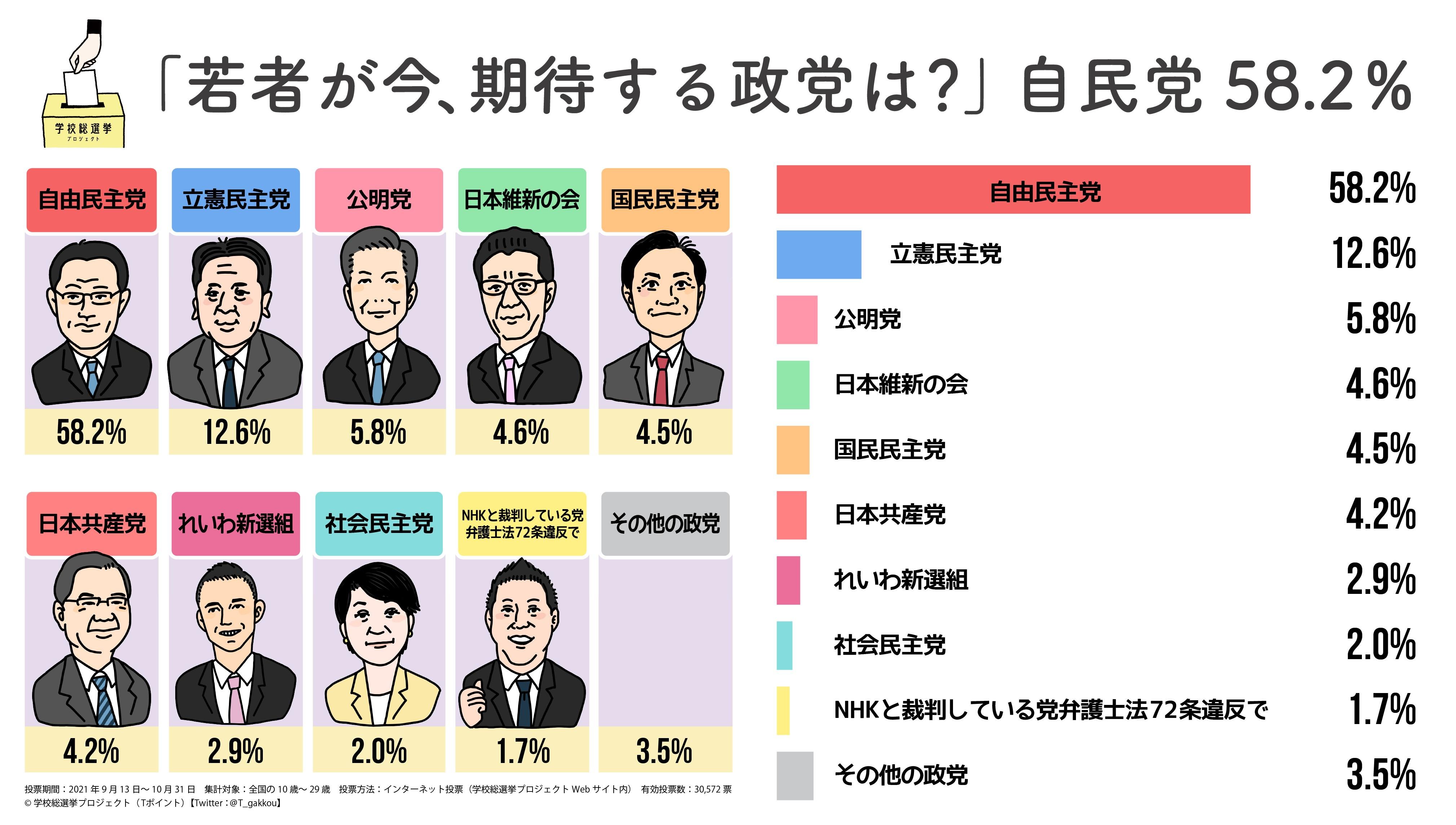
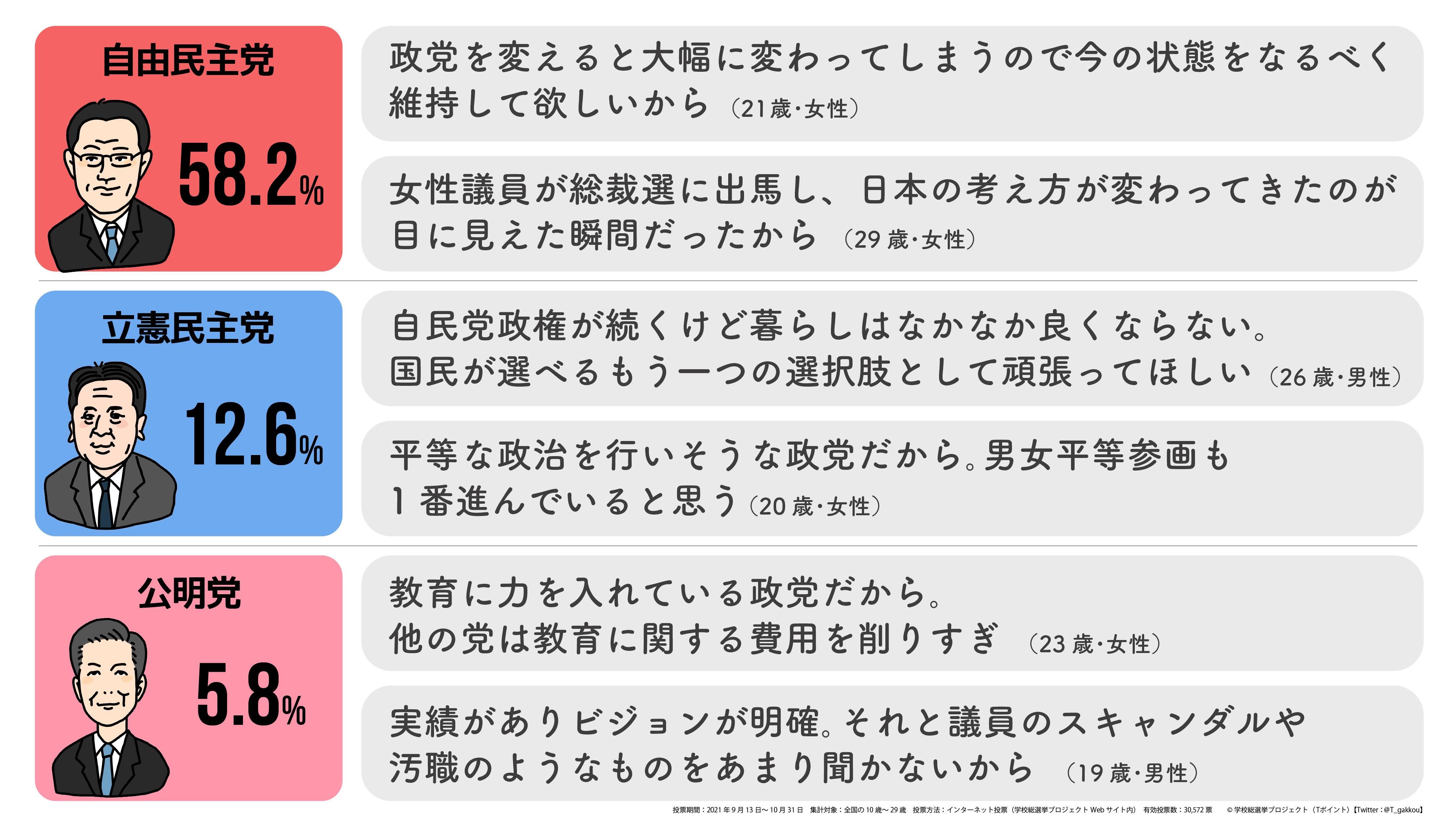
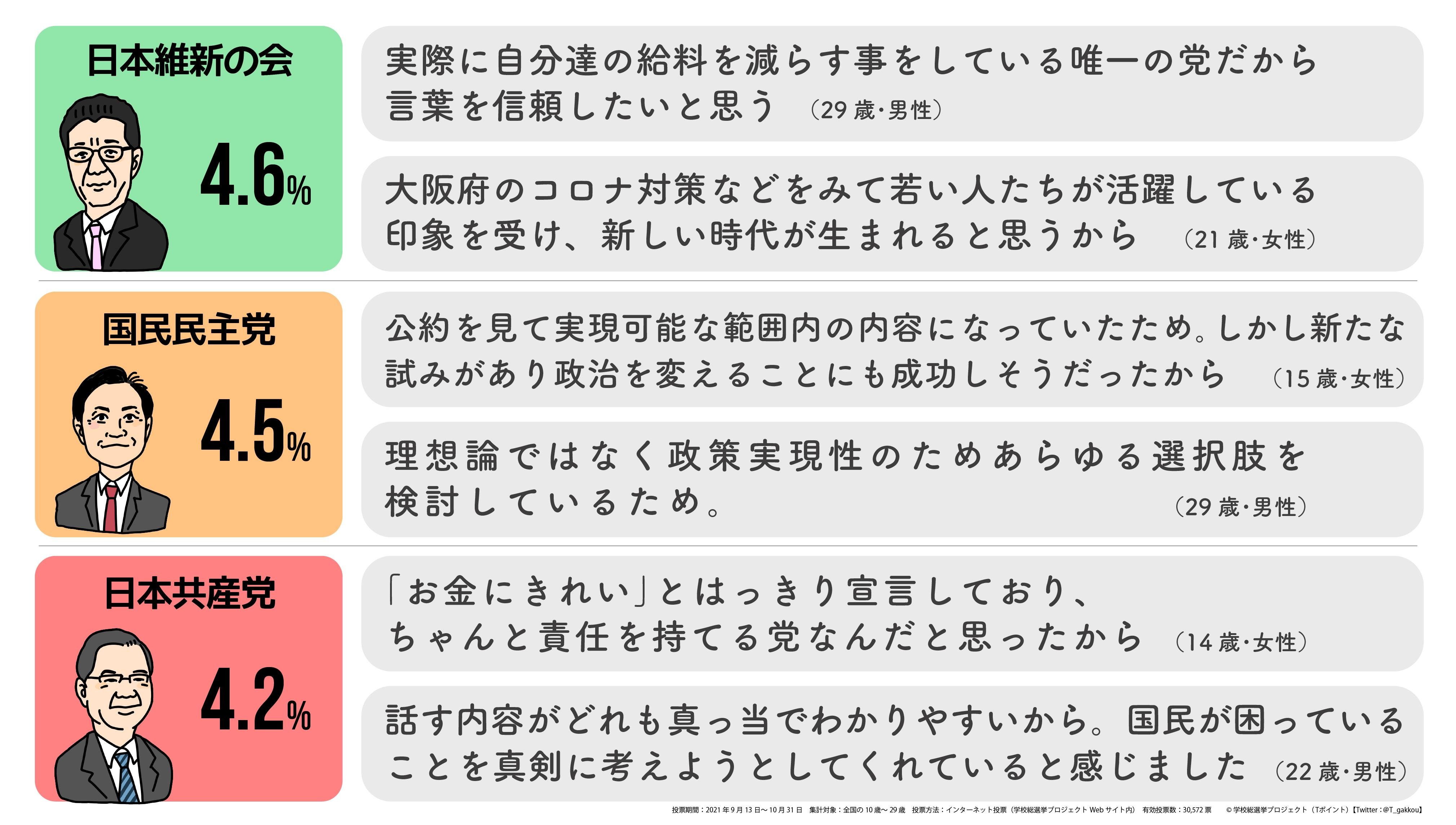
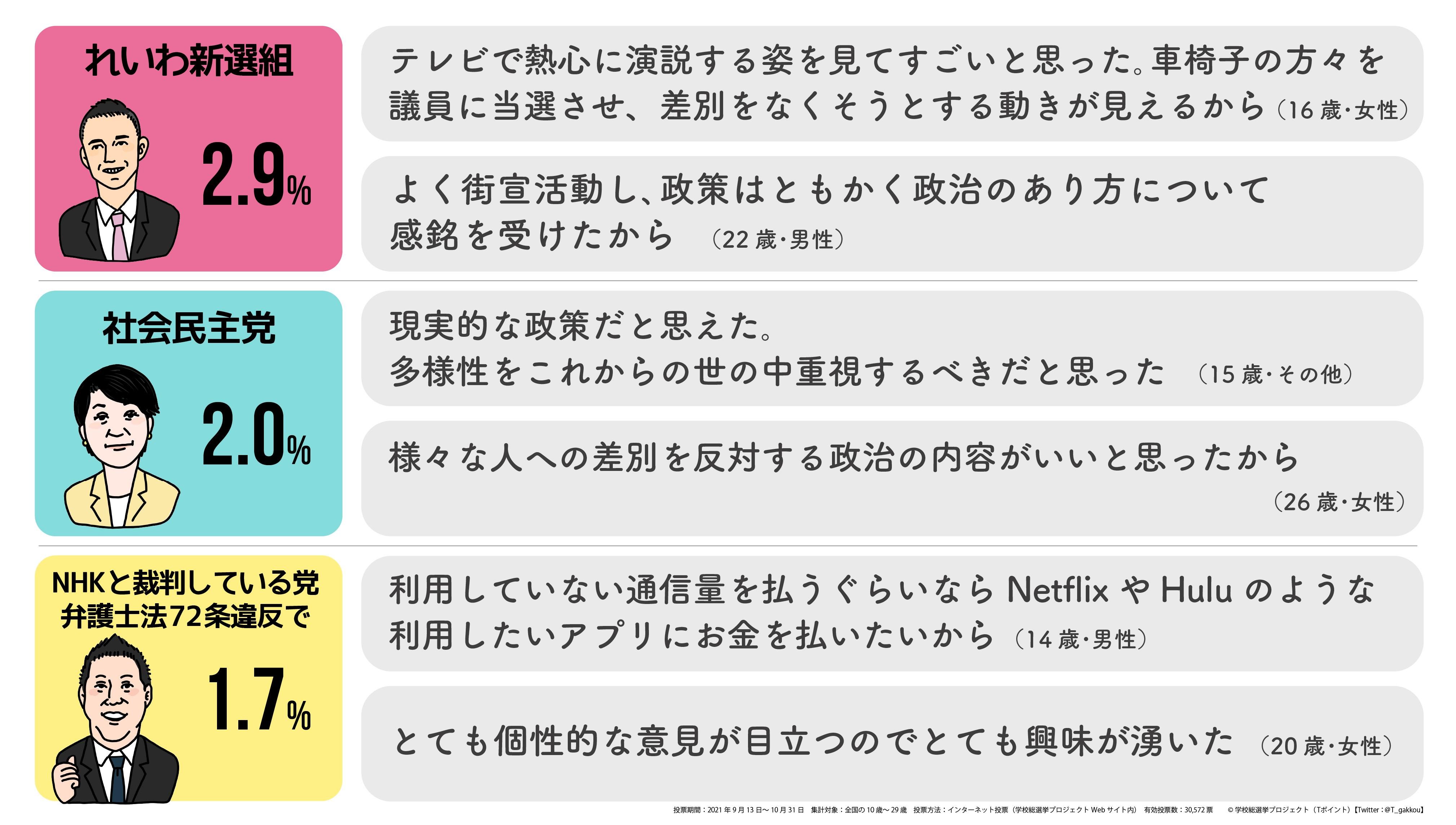
As a result, nearly 60% of young people voted for the Liberal Democratic Party (58.2%), citing reasons such as "changing political parties would result in drastic changes, so I want the current situation to be maintained as much as possible," and "when a female lawmaker ran for the presidency, it was a visible moment that Japan's way of thinking was changing."Next, many young people voted for the Constitutional Democratic Party (12.6%), citing the following reasons: "The Liberal Democratic Party continues to rule, but our lives are not improving. "I hope they will do their best as another option for the people," "They are the party that seems likely to implement equal politics, and I think they are the party that is the most advanced in terms of gender equality," and other comments. Next were the Komeito Party (5.8%), the Japan Restoration Party (4.6%), the Democratic Party for the People (4.5%), the Japanese Communist Party (4.2%), the Reiwa Shinsengumi (2.9%), the Social Democratic Party (2.0%), the party currently in lawsuit with NHK for violating Article 72 of the Lawyers Act (1.7%), and other political parties with 3.5%. The percentage of votes received by each political party was announced in the interim report of October 2021 (https://prtimes.jp/main/html/rd/p/000000684.000000983.html) no significant changes were observed.
Comment from Hiroki Ishii, project leader of the "School General Election Project"
We conducted a similar voting campaign in October 2020, when the Suga Cabinet was formed, but the number of votes this time was about three times higher, which showed us that young people are becoming more interested in politics and elections. We have also received positive feedback, such as a woman in her 20s telling us that the voting initiative in this project inspired her to vote for the first time.
Looking at the reasons given for choosing each political party this time, it appears that people did not only rely on reference information provided by the project, such as "as a result of playing Vote Match," "because a woman was running in the presidential election," or "after hearing what they said on TV," but also that they actively gathered information and made a comprehensive judgment before voting.
I believe that if there are more opportunities to introduce and ask about political parties' ideas and differences with other parties on television, the web, and social media, not just when elections are approaching, but on a more regular basis, we will see an increase in interest in politics, political parties, and politicians, and more people taking independent action, as in this case.
Through the "School General Election Project," CCC Marketing and T-Point Japan aim to foster "global citizenship" among young people, enabling them to proactively engage in, make decisions about, and take action on social issues, leading to the achievement of SDG Goal 4: "Ensure inclusive and equitable quality education and promote lifelong learning opportunities for all."With our group mission of "UNIQUE DATA, SMALL HAPPY," we aim for "T" to be a presence that "connects people and society," and we will continue to work to create new social value.
"School General Election" Service Overview
■Project name: School General Election Project
■Project site:https://youthvote.tsite.jp/
■Project start date: Tuesday, October 13, 2020
■Project details: The "School General Election Project" is based on CCC's founding intention of "providing a base for young people with information on new lifestyles," and is a "place" where young people who will be responsible for the future can co-create new discoveries and ideas that will serve as the foundation for living in the future. Aimed at the younger generation, from junior high and high school students to those in their 20s, we will raise themes related to issues affecting the future generation of young people from a wide range of areas, from politics and social issues to higher education and school, and provide neutral information on the issues raised and a forum for deeper dialogue among people of the same generation. By actually "voting" on the website, we will create an opportunity for each junior and senior high school student to take an active role and express their opinions. We also plan to publish articles on note reporting on the voting results that compile the "voices" of junior and senior high school students, as well as interviews with experts, and provide a forum for planning and holding dialogue with opinion leaders.
■Twitter account: School General Election Project [Official] https://twitter.com/T_gakkou
■Note account: School General Election Project [Official] https://note.com/t_gakkou
Summary of the vote on "Most desirable political party"
■ Voting period: Monday, September 13th, 2021 to Sunday, October 31st, 2021
■Voting method: Online voting
■Voting area: All over Japan
■ Voting age: 10-29 years old
■Number of votes: 30,572 votes
Materials related to this matter
[Final results announced] Young people's preferred political parties are the Liberal Democratic Party (LDP) at 60% and the Constitutional Democratic Party (CDP) at 10%. They tend to gather information independently and vote based on a comprehensive judgment.Inquiries regarding this matter
CCC Marketing Co., Ltd./T Point Japan Co., Ltd.
Public Relations Officer: Hatanaka TEL: 03-6800-4464
If you resonate with the content of this site, please feel free to share it.


