
[Ethical Consumption Study Group] Announcement of a marketing framework for ethical consumption in the food sector
2023.04.27
Press Releases
CCC MK HOLDINGS Co., Ltd.
- Increasing awareness of "ethical" is the key to creating an ethical food market -
CCC MK HOLDINGS Co., Ltd. (Head office: Shibuya-ku, Tokyo; President and CEO: Yasunori Takahashi; hereinafter referred to as "CCCMKHD") held the 6th "Ethical Consumption Study Group" (https://note.com/note_ethicalfood/n/n4b433e13dccf) online on March 31, 2023, with the participation of distributors, manufacturers, and experts. The Ethical Consumption Study Group has concluded its activities with this sixth meeting, and as a result, it has announced a marketing framework for ethical consumption in the food sector, along with recommendations for the "T-CARD Everyone's Ethical Food Lab."
The "Ethical Consumption Study Group" is a collaborative platform run by CCC Marketing called "T-CARD Everyone's Ethical Food Lab" (https://ethicalfoodlab.tsite.jp) and aims to conduct research into ethical consumption among consumers, focusing on the area of food, through collaboration with a wide range of parties, including companies, educational institutions, and local governments.

Participants of the 6th "Ethical Consumption Study Group" *In alphabetical order
- Ajinomoto Co., Inc.
- Kodawariya Co., Ltd.
- House Foods Group Inc., House Foods Corporation
- FamilyMart Co., Ltd.
- Meiji Holdings Co., Ltd.
- Mariko Kawaguchi (Rikkyo University, Fuji Oil Holdings Co., Ltd.)
- Hiroko Sasaki (Chefs for the Blue General Incorporated Association)
- Yugo Nakamura (Assistant Professor, Graduate School of Information Science and Electrical Engineering, Kyushu University)
- Kenji Yamamoto (Good Tables Co., Ltd.)
- 1 other company
Marketing framework for ethical consumption in the food sector
At "T-CARD Everyone's Ethical Food Lab," we believe that "1,000 people who are occasionally ethical have a greater social impact than 100 people who are extremely ethical." According to the UK's Ethical Consumer Research Association, even in the UK, a country that is a leader in ethical practices, only a small percentage of people are "always ethical" and only purchase ethical products. On the other hand, it is said that 20-30% of people do not buy or are not interested in ethical products. Among these, the behavior of "people who sometimes buy ethical products," who account for more than half of the total, is expected to become a huge market.
First, there is the stage of becoming aware of "ethical," and even among those who are aware, there are those who understand the content and those who are unclear about it and do not really understand it. Whether their cognitive state is clear or unclear, there are people who choose foods with ethical considerations in mind and put them into practice. Furthermore, even among those who practice ethical food, there are those who always choose ethical food and those who only occasionally choose ethical food, depending on how often they do so. Attitudes change when moving through each status, but in the stage from unawareness to awareness, communications from the media, in-store, and manufacturers are key points. Furthermore, even among those with cognition, stimulating intellectual curiosity is key to moving from a state of unclear understanding to a state of complete knowledge of the content. In the stage of moving from no practice to practice, the key points are to appeal to specific issues such as fair trade and child labor, and to discover that there are ethical products among the products you normally purchase. Also, for those who are practicing it, the key point is to empathize with the concept of "ethical" itself.
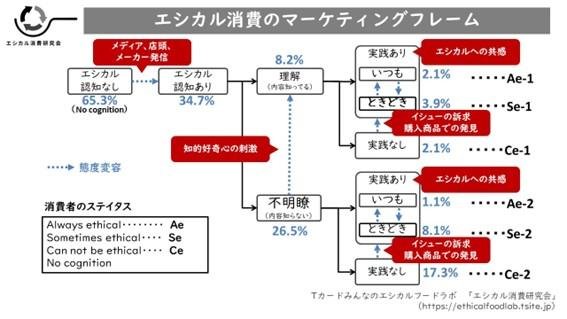
Proposal from "T-CARD Everyone's Ethical Food Lab"
Awareness of "ethical" is increasing year by year, and the number of consumers who are conscious of ethical choices when purchasing food and beverages is definitely on the rise. The current awareness rate is 34.7%, while only 15.2% of people actually purchase products with ethical considerations in mind. If awareness were to rise to 40%, and the number of practitioners were to remain the same as it is now, the figure would reach 17.5%. This number exceeds the 16% of innovators and early adopters combined in the innovator theory, and can be interpreted as the beginning of the spread to the early majority. It is said that new products and trends spread rapidly once the rate exceeds 16%, and it is believed that this time is fast approaching in the ethical food market as well.
Therefore, it is important to first increase awareness and ensure that more than 16% of people are practicing ethical food, thereby creating an ethical food market. In order to raise awareness, efforts across the entire food chain and media initiatives are also important. In order to increase the level of understanding among those who are aware of the issue, it is necessary to disseminate information that will help them actively gather information. In doing so, it is hoped that students will satisfy their intellectual curiosity, as well as their desire to understand and enrich their own lives, and to consider how the subject will relate to their own lives.
Additionally, when disseminating information, it is also effective to inform customers that each product is ethical. Knowing that the products they have already purchased are ethical makes them feel that their own actions are being affirmed, which can lead to repeat purchases and the establishment of ethical consumption in general. In Japan, people who are aware of ethical practices but do not practice them are considered to be a floating group that may start practicing them if their understanding improves, so it is hoped that knowing which products are ethical could lead to behavioral change.
Furthermore, it is also necessary to communicate individual issues. At this stage, ethical issues are not widely known, so we believe it is necessary to start by communicating the issues. In addition, when it comes to issues, people tend to focus too much on "food waste," so by communicating a wide range of ethical-related issues and bundling them together under the word "ethical," it may be possible to create a synergistic effect from each individual initiative. Communicating the "facts" of your initiatives is extremely important in order to prevent advertising from being washed away. Furthermore, since empathy for "ethical" can be a reason for ethical consumption, it is thought that using the word "ethical" when communicating is effective.
Comments from participants of the Ethical Consumption Study Group
- When developing products, there was talk of being ethical within the company, but we were unable to see any value in it. It was a big realization for me that producers, both large and small, have a responsibility to act ethically. I would like to share this with the buyers I will need to speak to first in future business negotiations.
- When I give lectures at elementary and junior high schools, I am aware that young people are conscious of ethics. On the other hand, it seems that consumers are not entirely sure which products are ethical. Isn't it necessary for each company to send out a message based on a common understanding?
- With the rapid changes in society, the way we consume will undoubtedly be different in 10 to 20 years, so I think it is our mission to see how far we can move it in the direction of ethical consumption.
- Expanding ethical consumption is a theme for each company in the future. We intend to create social value, but if we become self-centered, it will not be of value to our customers. The themes going forward will be how much of the story can be told, how to make it valuable to customers, and how much empathy can be gained from customers.
- We still feel that unless we can balance customer value and social value, our products will not be accepted. Society is constantly changing, so in order to avoid being left behind, I feel that rather than waiting, it is necessary for companies to continue to communicate and release products.
- The world is constantly changing, so we need to continually think about what we can do in this environment. It was great to talk to people from other companies. It would be great if we could collaborate on a project in the future.
- From here on, we need to create a movement for ethical consumption. It would be good to collaborate on something during the implementation stage.
- In order to encourage changes in customer behavior, companies understand that they need to take continuous action, such as disseminating information and providing products, but this is an area that is difficult to enter. I would like to create an opportunity for people within our company to take on this issue with determination.
- We have tried several ways to create products that could be considered ethical, but there was no connection between intellectual understanding and consumer behavior. Creating the framework helped me to clarify what the most important points were. It is difficult to pass on ethical elements to prices. First of all, I think it's good to have people buy delicious food, to give it value and buy it at a fair price, and to have a story attached to it. It would be difficult for one company to do this alone, so it would be good if we could do something together.
This marks the end of our activities as the Ethical Consumption Study Group. We hope that the marketing framework we have created together with people involved in the food chain will be utilized to promote ethical food in the future.
Materials related to this matter
[Ethical Consumption Study Group] Announcement of a marketing framework for ethical consumption in the food sector
Inquiries regarding this matter
CCC MK HOLDINGS Co., Ltd.
Public Relations Office: Ando
TEL: 03-6800-4464/MAIL: cccmkpr@ccc.co.jp
If you resonate with the content of this site, please feel free to share it.


