
Co-creation platform "V Everyone's Ethical Food Lab" holds second "Food Sustainability Forum 2024"
2024.10.31
Press Releases
CCC MK HOLDINGS Co., Ltd.
-Can ethical products become consumer value?-
CCC MK HOLDINGS Co., Ltd. (Head office: Shibuya-ku, Tokyo; President and CEO: Yasunori Takahashi; hereinafter referred to as "CCCMKHD") is working on a co-creation platform called "V Minna no Ethical Food Lab" (https://ethicalfoodlab.tsite.jp/) held the second Food Sustainability Forum 2024 on Tuesday, October 22, 2024.
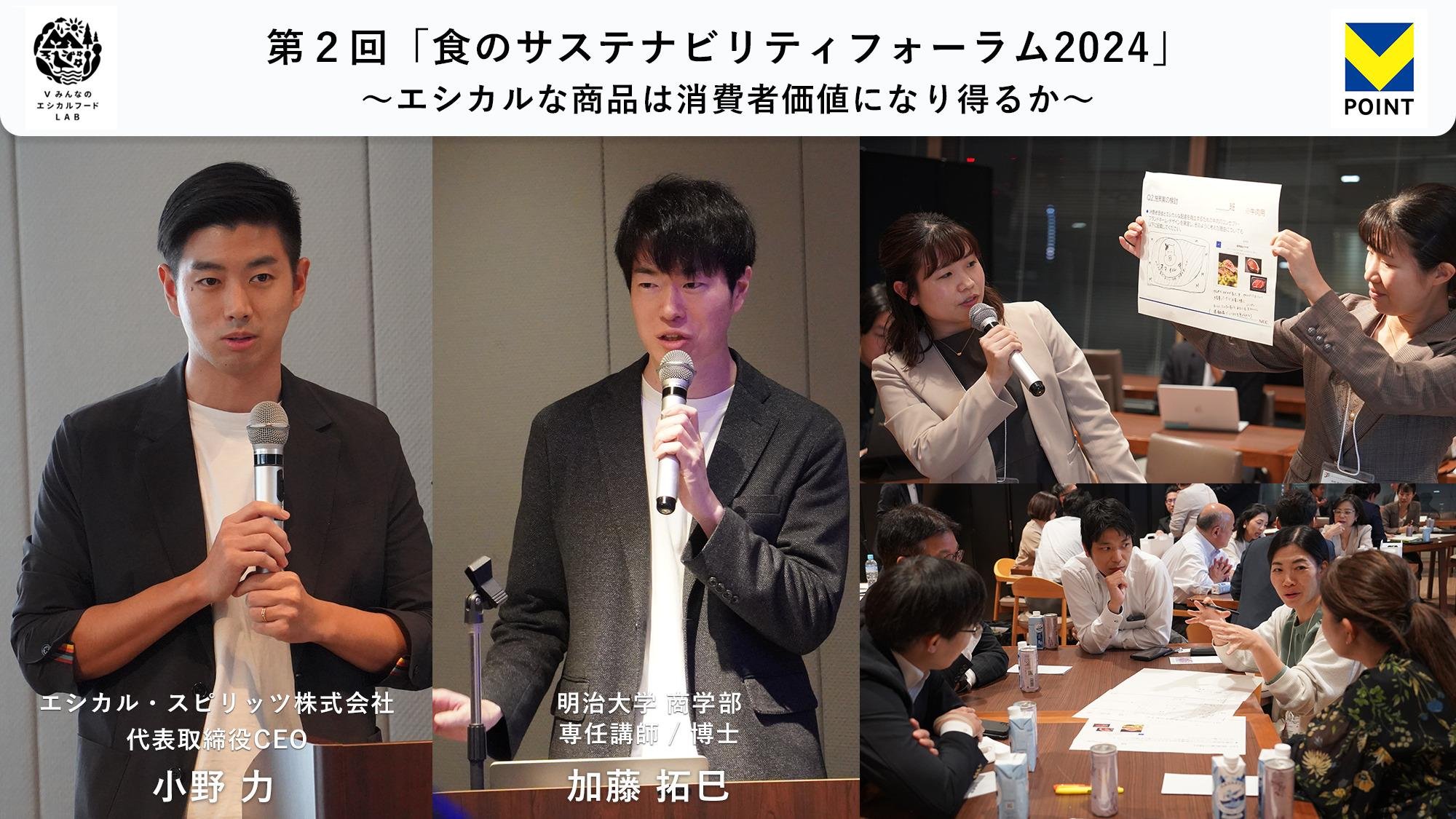
The Food Sustainability Forum 2024 aims to clarify the consumer value of ethical food by providing information that will lead to suggestions on how to create and communicate consumer value for ethical products based on analysis of V POINT purchasing data and survey results, as well as case studies from various companies. Starting with the first session on Friday, July 19th, a total of four sessions are planned, with participation from stakeholders across various industries, including food manufacturers, distributors, and tech companies.
About the 2nd Food Sustainability Forum
CCCMKHD held its second Food Sustainability Forum on Tuesday, October 22nd in Shibuya, Tokyo. A total of 25 people participated from Ethical Spirits Co., Ltd., Kyodo News Inc., Sagamiya Foods Co., Ltd., Seven & i Holdings Co., Ltd., TNC Corporation, Nichirei Foods Inc., NEC Corporation, House Foods Group Inc., House Foods Corporation, Hitachi Solutions Ltd., Mizkan Holdings Inc., and Meiji Holdings Co., Ltd. (listed in alphabetical order).
In the first half of the event, titled "Sharing Marketing Case Studies of Ethical Products," Tsutomu Ono, CEO of Ethical Spirits Inc., gave a presentation on the marketing of craft gin, which is made from underutilized sake lees and is attracting attention as an advanced example for a startup company.
In the second half of the event, Takumi Kato, a full-time lecturer at the School of Commerce at Meiji University and PhD, gave a presentation entitled "Methodology for Creating Value Based on Concepts and Its Application to Ethical Consumption," in which he shared the importance of creating concepts based on consumer value in marketing, as well as the latest research results on consumer value in ethical products.
Sharing examples of ethical product marketing (excerpts)
Tsutomu Ono, CEO of Ethical Spirits Co., Ltd.
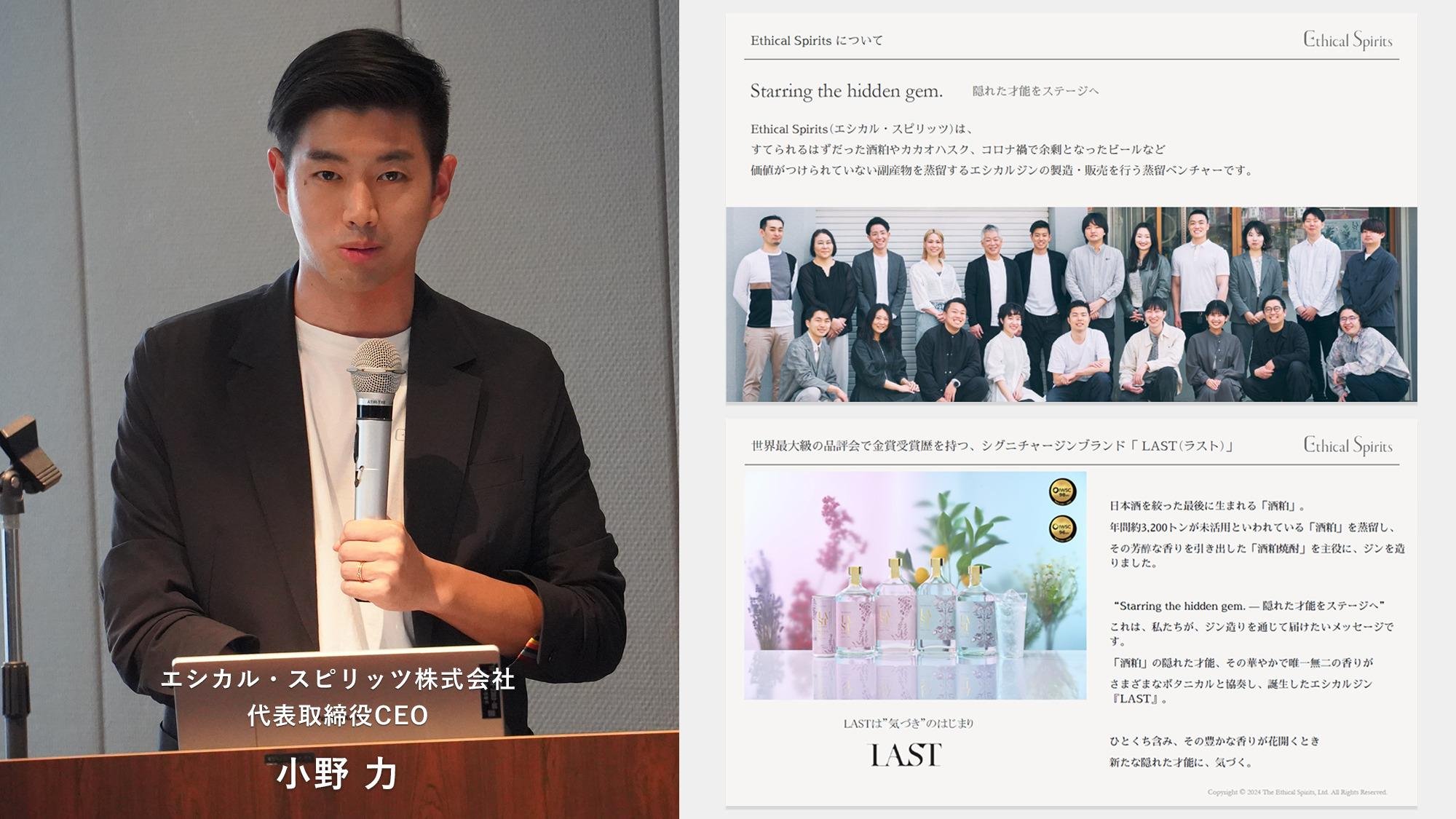
Ethical Spirits Co., Ltd., founded in 2020, is a manufacturer that produces mainly distilled spirits, including upcycled craft gin, with the corporate message "Starting the hidden gem."We have been delivering the value of unused materials that are often discarded, such as sake lees and cocoa husks (the outer skins of cocoa beans), to our customers through the distillation process.
In the midst of this, I felt there was a big gap between the social value being communicated and actual consumer trends. In the early stages, our company promoted our product through communication that emphasized "adding value to something that would otherwise be wasted," such as "Made from sake lees that would otherwise be thrown away," but advertising it by highlighting our award history and the fact that "we have a distillery in Tokyo" proved more effective. Furthermore, in an external survey, more than 60% of consumers who answered that they "only buy ethical products" also answered "for products under 5,000 yen," indicating that ethical and sustainable elements are not directly linked to purchasing motivations for our products, which are luxury items. That's why we strive to design communications that take into account the rich aroma of the sake lees used as an ingredient, functional values such as "being a rice-based alcoholic beverage that pairs better with food than other gins," and emotional values such as "in what situations and emotions would you want to drink it?"
At the same time, we also saw many customers talking to each other about our gin production methods and philosophy. Rather than placing a price on ethical products themselves, we believe that the experience of "what I thought was delicious is actually ethical" created by making convincing quality the basic premise is what greatly contributes to customer retention and loyalty.
Concept-based value creation methodology and its application to ethical consumption (excerpt)
Takumi Kato, Ph.D., Lecturer, School of Commerce, Meiji University
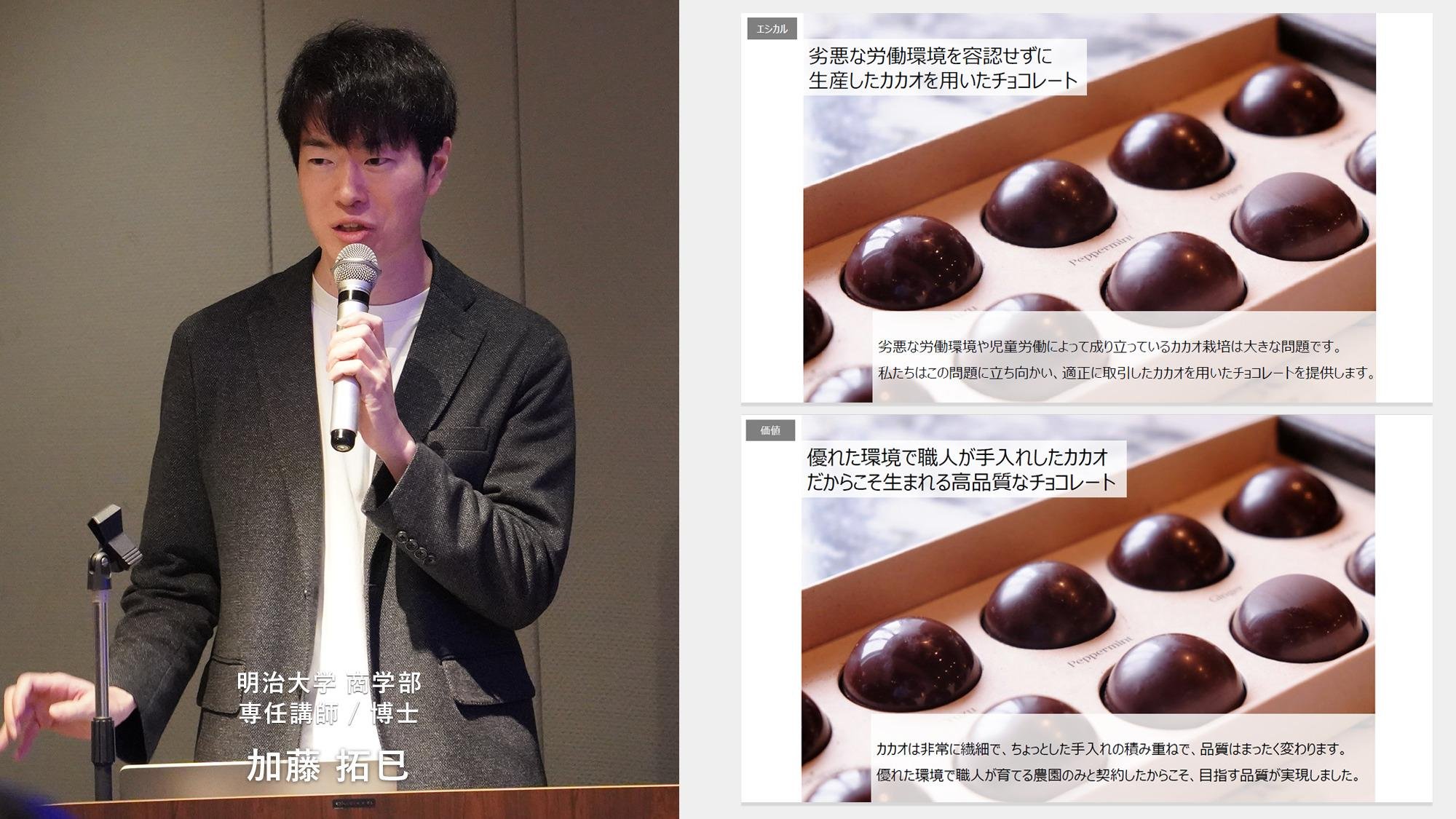
The essence of marketing is "creating value that makes sales unnecessary," and the concept that defines the value of a product or service is important. The conceptual framework is Who (what kind of people are struggling with), What (what), and How (how). Among these, the most important thing to consider is Who. Who clarifies what practical and psychological problems people are facing, rather than just identifying attributes such as "women in their 20s."Because value comes from solving problems. In marketing communications, it is important to create strong empathy by focusing on consumers with problems and telling a story in which the brand solves them.
The same concept of value creation applies to ethical products. Social aspects such as environmental considerations and human rights protection are not values that individual consumers have. Therefore, in order to balance social significance and consumer value, the first step is to identify the desires of individual consumers. For example, consumers want solutions to problems such as "I'm on a diet, but I want to eat a hearty meal" or "I want to take a break at work and reduce stress."However, the strongest human desire when it comes to food is "the desire to eat something delicious."Therefore, it is necessary to develop a concept that links ethical characteristics to these needs.
In fact, research on ethical coffee has traditionally focused on resolving the poverty issues facing producers, but it has been found that the product's appeal can be enhanced by the concept of "quality resulting from good working conditions on the farm."Similarly, research on chocolate has shown that by changing the label from "chocolate made with cocoa produced without tolerating poor working conditions" to "high-quality chocolate made with cocoa cared for by artisans in excellent conditions," consumer purchasing power increases and the price becomes more affordable.
When it comes to fresh foods such as eggs and beef, appeal has traditionally been made from the perspective of animal welfare. Rather than saying, "We are committed to raising animals with the determination to not tolerate the method of cramming them into small cages," we say, "We raise animals in a comfortable environment with minimal stress, ensuring high quality. They also get a lot of exercise and are low in fat. We have formulated the concept:This is the same logic as saying that "Naruto sea bream raised in the Naruto Strait, where the currents are fast, have firm flesh and are delicious."Furthermore, based on this concept, we will embody the product name ("Bitennen") and packaging (natural paper material). As a result, compared to traditional promotional methods, consumers rated the product highly, saying it looked "tasty."
In this way, we will clarify how ethical characteristics contribute to solving consumer desires and problems and develop concepts. Of course, to avoid greenwashing, once a concept has been formulated, it is important to scientifically substantiate it and realize it. However, companies that excel at creating value must first establish a concept that defines the reason for the existence of their product or service, and then must be strongly aware of developing the technology to achieve that purpose. Even with ethical products, it is possible to achieve both social significance and consumer value by starting by formulating a concept.
Comments from participants
Toshiya Minami, General Manager of Sustainability Promotion Department, House Foods Group Inc.
This lecture and workshop was very interesting. Ethical values are not a strong motivation for purchase, and I used to think that consumer value came first. However, I learned that the breakthrough lies not in hiding ethical values, but in linking them to loyalty and using them to solve customers' problems. I feel that it is more difficult to translate consumer value into processed foods where the ingredients are less apparent, so I hope to see further breakthroughs.
The third Food Sustainability Forum is scheduled to be held in January 2025. The talk will be titled "Unraveling the affinity between ethical products and Generation Z, the future consumer demographic," and will feature presentations from TNC Co., Ltd.'s Director Yuki Kishimoto on advanced examples from overseas, and from ETHICAL EXPO JAPAN's Representative Naoto Nurino on the results of a survey of Gen Z's attitudes in Japan (content is subject to change).
CCC MK HOLDINGS will work with all stakeholders involved in food, including consumers, manufacturers, and distributors, to help ethical food become more widespread in society, and each and every activity of the "V Everyone's Ethical Food Lab" will contribute to creating a food cycle that will connect to the future.
Materials related to this matter
Co-creation platform "V Everyone's Ethical Food Lab" holds second "Food Sustainability Forum 2024"
For inquiries regarding this matter:
CCC MK HOLDINGS Co., Ltd.
Public Relations Office TEL: 03-6800-4464 / MAIL: cccmkpr@ccc.co.jp
If you resonate with the content of this site, please feel free to share it.


