
Co-creation platform "V Everyone's Ethical Food Lab" holds first "Food Sustainability Forum 2025"
2025.11.26
Press Releases
CCC MK HOLDINGS Co., Ltd.
-What is ethical value for consumers?-
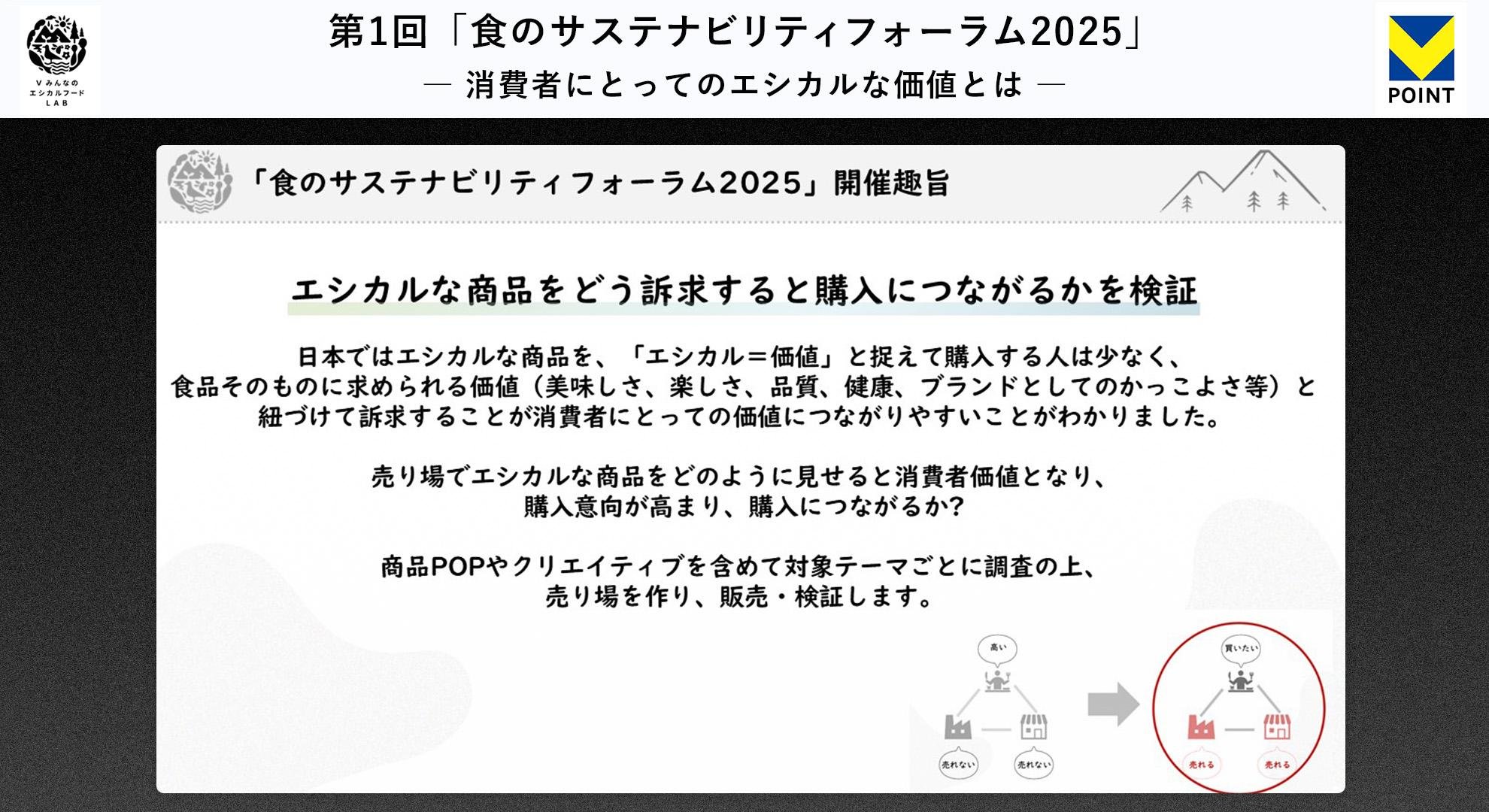
CCC MK HOLDINGS Co., Ltd. (Head office: Yokohama, Kanagawa Prefecture; President and CEO: Yasunori Takahashi) is working on a co-creation platform called "V Everyone's Ethical Food Lab" (https://ethicalfoodlab.tsite.jp/) held the first Food Sustainability Forum 2025 on Wednesday, November 12, 2025.
The Food Sustainability Forum 2024, held four times last year, brought together stakeholders from across industries and sectors, and revealed that Japanese consumers rarely choose ethical products based on their "social value" alone, but rather increase their purchasing desire by linking them to the value of the food itself, such as deliciousness, enjoyment, quality, health, and brand value. Based on this knowledge, the Food Sustainability Forum 2025 is examining how ethical products can be presented on the sales floor so that they are perceived as valuable by consumers and lead to purchases, including product messaging.
■About the 1st "Food Sustainability Forum 2025"
CCC MK HOLDINGS held the first "Food Sustainability Forum 2025" online on Wednesday, November 12th. A total of 32 people participated from AEON Retail Co., Ltd., S&B Foods Co., Ltd., Kewpie Corporation, Kewpie Egg Co., Ltd., Seven-Eleven Japan Co., Ltd., Seven & i Holdings Co., Ltd., Nichirei Foods Co., Ltd., Nichirei Fresh Co., Ltd., Harashin Narus Operation Service Co., Ltd., Hitachi Solutions Ltd., Mizkan Holdings Co., Ltd., Meiji Holdings Co., Ltd., and United Supermarkets Holdings Co., Ltd. (in alphabetical order).
Review of the Food Sustainability Forum 2024 and action plans for 2025 / Sharing of the results of the Ethical Consumption Survey 2025 (excerpt)
CCC MK HOLDINGS Co., Ltd.
Nozomi Takita, leader of "V Everyone's Ethical Food Lab"
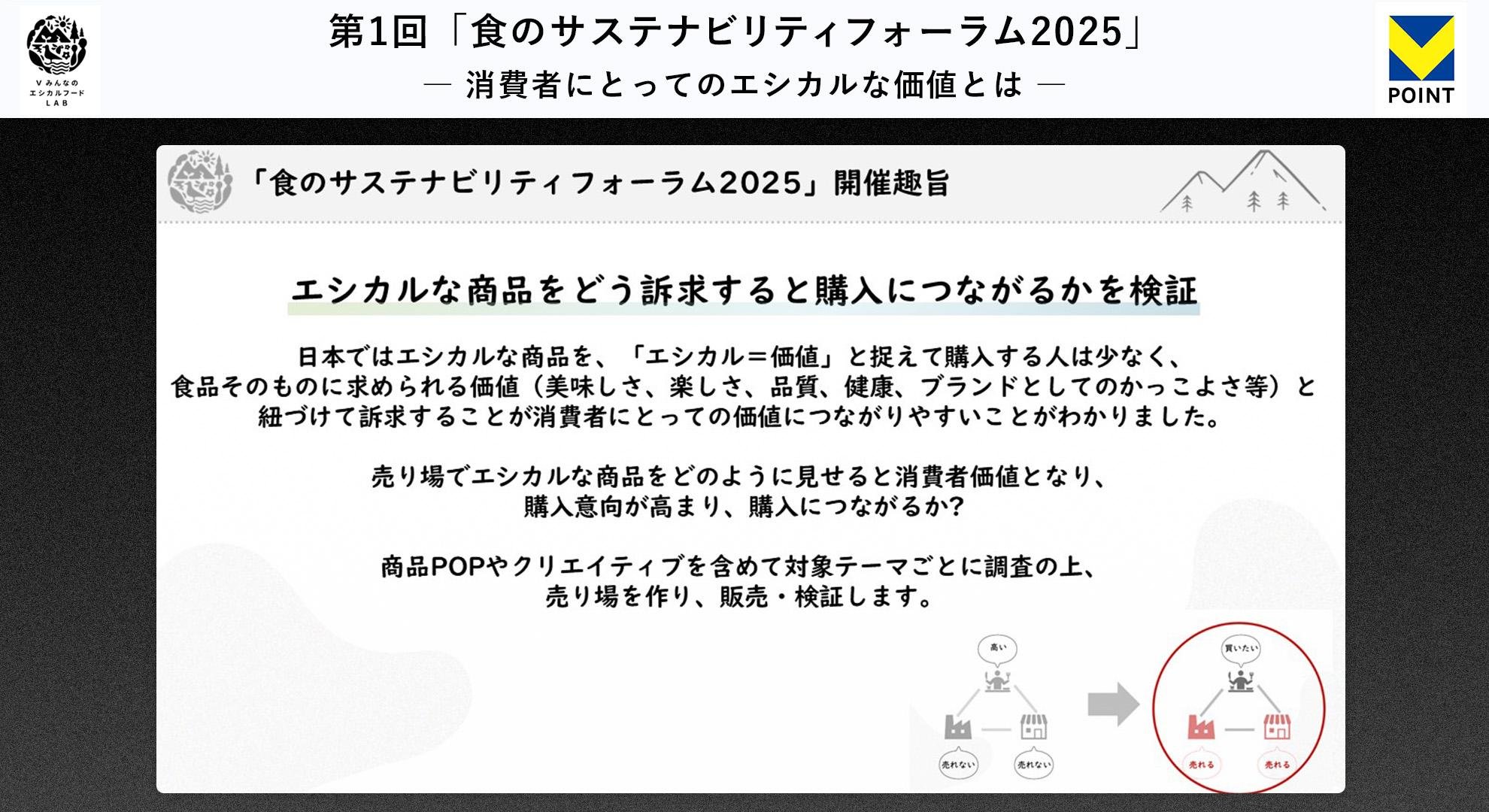
[Looking back on the Food Sustainability Forum 2024 and action plans for 2025]
Launched in March 2021, "V Everyone's Ethical Food Lab" is a project that utilizes V POINT purchasing data to challenge the creation of social value. With the theme of "sustainable food," a global issue, we have been investigating the current state of ethical consumption, raising awareness among stakeholders, and investigating changes in consumer attitudes through sales demonstration experiments.
Since last year, we have entered the social implementation phase, and have been holding the Food Sustainability Forum four times a year. The event began with a dialogue about "the future of food we want to achieve," and then deepened the discussion on the consumer value of ethical products, including verifying the consumer value of ethical products through surveys and data analysis, delving deeper into the perspectives of Generation Z, and sharing the results of initiatives and pilot experiments at the distribution site. As a result, it became clear that the key is to communicate ethics as "added value" rather than as a sense of obligation, and that communication and product development that converts ethical value into consumer value will be the breakthrough.
This year, we will be examining how to promote ethical products in sales areas in connection with the deliciousness and quality of the food itself, with the theme of "How can we promote ethical products to encourage purchases?"
[Sharing the results of the 2025 Ethical Consumption Survey]
In June 2025, we conducted an online survey of 2,000 V members to understand the current state of ethical practices. As a result, awareness of ethics rose to 43.7%, a 3-point increase from last year. On the other hand, although comprehension of the content is high among younger generations (especially women), it remains at 12.2% overall.
Regarding purchase intentions, 40.4% responded that they "want to buy" or "somewhat want to buy," but many people cited "I don't know what products are ethical" as the reason for not purchasing. In addition, there are strong demands for companies that manufacture and distribute ethical food to "make it easier to understand how it is ethical" and "lower the price."
These results show that while ethics encompasses a wide range of topics, detailed understanding has not yet been fully established. Furthermore, although there is a certain degree of intention to purchase, the fact that people are unsure whether the product is ethical or not is thought to be an inhibiting factor. In corporate initiatives, the first prerequisite is to "clearly state ethical issues," and then an important issue going forward will be how to link ethical values to consumer value and promote them.
■ Message value verification survey results for each ethical theme and ethical product Share / Ethical Food Fair development report (excerpt)
"V Everyone's Ethical Food Lab" Secretariat
Chisato Yuasa
[Sharing survey results to verify message value by ethical theme and ethical product]
Through last year's forum, it was recognized that it is important for ethical consumption to balance social significance with consumer value that satisfies individual desires.
Therefore, in June 2025, an online survey was conducted targeting 2,000 V members, targeting seven themes based on the "Ethical Food Standards" formulated by the "V Everyone's Ethical Food Lab" (organic, fair trade, animal welfare, sustainable cocoa, sustainable seafood, upcycled food, plant-based food). Four consumer value elements were set (ethical: ethical manufacturing processes are valued; quality: improved quality through ethical efforts is valued; safety and security: food safety is valued through ethical efforts; self-desire: ethical efforts fulfill the desire for peace of mind, satisfaction, and the joy of supporting others) to examine which elements lead to "consumer value beyond price differences."
As a result, it was found that values such as a sense of security and satisfaction, which are included in "self-desires," are likely to be linked to consumer value across five themes (fair trade, animal welfare, sustainable cocoa, upcycled food, and plant-based food). Additionally, the item with the highest percentage of respondents who answered that they would be willing to buy even if it meant paying more for the price was "upcycled food," followed by "sustainable seafood."Furthermore, by gender and age, it was found that young people in their teens and twenties and those in their fifties were more likely to overcome the price difference, while men in their thirties and forties were less likely to overcome the price difference.
We also conducted a survey to find appealing messages that would lead to consumer value for the ethical products submitted by each company. In an online survey, 2,000 V members who "shop at the supermarket at least once a month" were asked to choose from several message patterns that combined the ethical value of the product itself with the value specific to the product, and to examine which message most made them "want to buy" the product, even if it was more expensive than regular products.
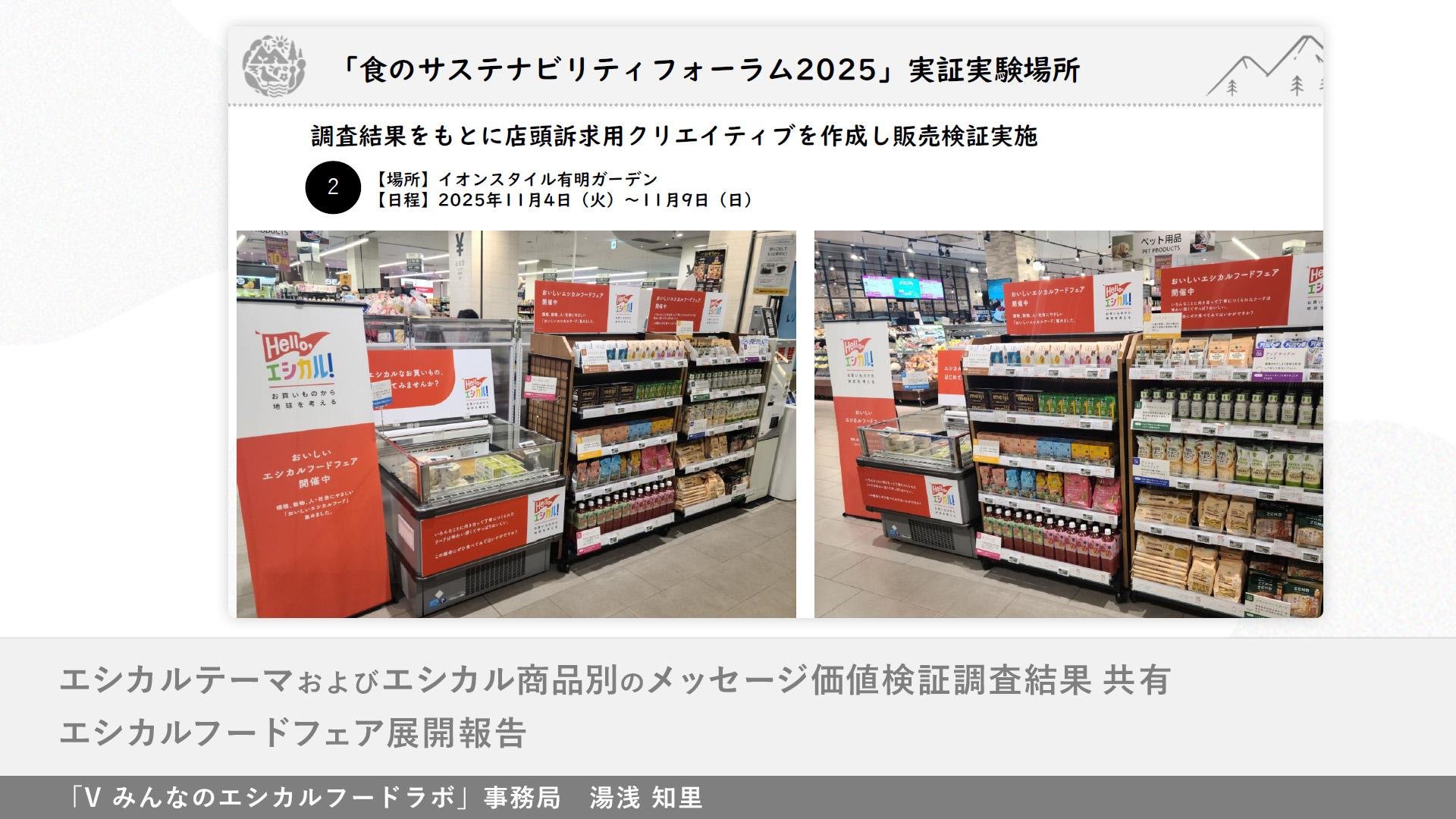
[Ethical Food Fair Development Report]
Based on these survey results, we created theme POPs that reflected the messages that had the highest consumer value for each theme, and product POPs that used the messages that most increased purchase intent for each product, and conducted sales tests at Daikanyama T-SITE and AEON Style Ariake Garden. At the actual site, we saw many interested customers, some of whom were looking closely at the products and others talking in groups about the POP. Detailed survey results will be shared at the forum in January 2026.
■ Examples of ethical food promotion in overseas retailers (excerpts)
TNC Co., Ltd.
Director Yuki Kishimoto
TNC Co., Ltd. has a vision of "Invigorating Japan from a global perspective!" and utilizes a network of approximately 600 Japanese partners who have lived in approximately 70 countries for many years. Even in the age of AI, the company's strengths lie in its ability to gather primary information and conduct real research from the consumer's perspective. The company also operates businesses on both the inbound and outbound fronts, including brand development and support for the overseas expansion of Japanese food products. This time, we will introduce how the seven themes based on the "Ethical Food Standards" are promoted in stores in ethically advanced countries such as Europe and the United States.
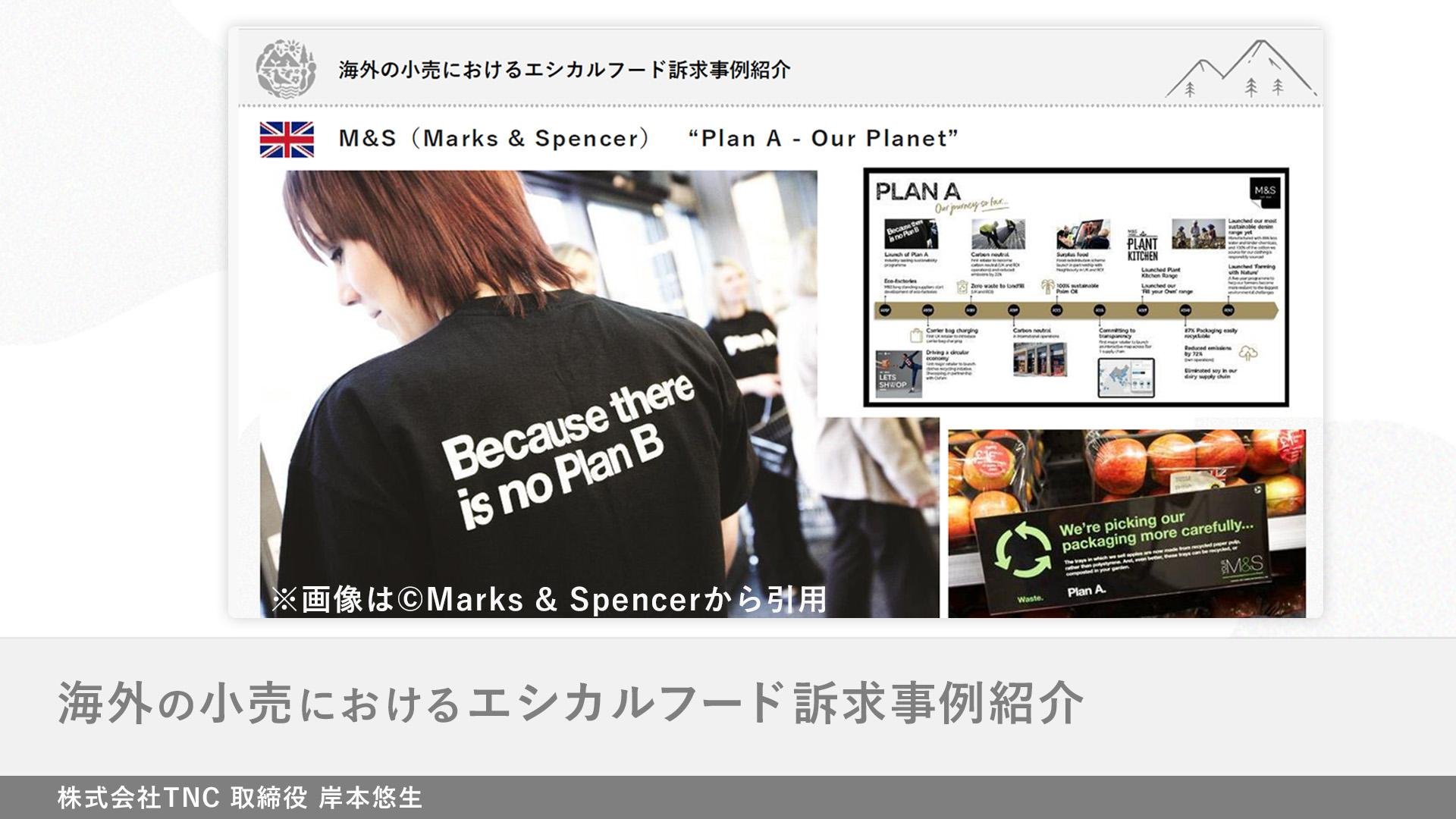
Marks & Spencer, a British supermarket for upper-income families, has been promoting a clear policy called "Plan A" since 2007, announcing the steps it will take to achieve this by 2040 and publishing its initiatives on its website. In addition, the store is promoting ethical products in an easy-to-understand manner under one clear pillar (Plan A), with a product lineup based on policies such as "100% British" (local production and consumption) and the catchy slogan "Because There is no Plan B."
REWE, a major German retail chain that is seeing a steady increase in its flexitarian (people who primarily eat a plant-based diet but occasionally eat meat or fish) customers, has created an impactful sales area in its dedicated plant-based shelves that clearly communicates the benefits of plant-based products. We are also working on container circularity initiatives in partnership with a deposit reuse container company, and by collaborating with a variety of businesses, not just food companies, we are communicating ethical issues in an easy-to-understand and accurate manner.
The American supermarket chain Walmart is also focusing on organic products, which are sold in a prominent area near the entrance. In addition, their own brand "bettergoods," which directly promotes the idea that ethical is "good," is conducting large-scale promotions, including offering free sampling in stores.
These examples suggest that it is important to foster awareness that ethical foods are "good" at storefronts. To achieve this, it is necessary to develop appealing messages that customers can easily relate to, such as POP displays that are common across the sales floor, as well as create systems such as "earning points through ethical consumption."On the other hand, companies are required to formulate a clear and catchy vision. For example, it is essential to clearly define the issues that must be resolved as a top priority, such as "Our company is committed to animal welfare," and to ensure transparency through a disclosure plan. It is also important not to rely solely on the government, but also for private sector-led activities to raise consumer awareness and understanding of ethics through "sometimes fun, sometimes forceful" initiatives. I believe that in the future, corporate collaboration, such as this forum, will be key to creating social impact in the ethical market.
■Comments from participants
Public Relations and Investor Relations Specialist and Sustainability Committee Member, S&B Foods Co., Ltd.
Daisuke Takayama
How to link ethical initiatives to value for consumers is a major theme for our company. The results of this survey provided us with very meaningful insights into what consumers value and what their thoughts are. As can be seen in examples of stores overseas, we believe it is our responsibility and role as a company to ensure that ethical practices are not just a "special choice" but are instead a "natural choice" for consumers. We have high hopes for the results of this demonstration sale, which was conducted across corporate boundaries.
Officer, Sustainability Promotion Office, Seven & i Holdings Co., Ltd.
Ayako Suzuki
Looking back on the process of our efforts so far, I felt that this year we have progressed to a concrete step of verifying "how to appeal to people to lead them to purchase."The results of this survey were very interesting, as it made it clear that the messages that pose value to consumers beyond price differences differ by ethical theme, as well as by gender and age. Furthermore, the results suggest that ethical values themselves have appeal among teenagers, which made me think. I feel that going forward, we will need to think individually about "who we are appealing to and what we are appealing to" depending on the characteristics of each product. We hope to learn from these examples together with all participants and work together to expand the ethical food market.
The second Food Sustainability Forum 2025 is scheduled to be held in January 2026. We plan to announce details of the sales verification of the ethical food fair conducted at Daikanyama T-SITE and AEON Style Ariake Garden. (Content is subject to change).
CCC MK HOLDINGS will work with all stakeholders involved in food, including consumers, manufacturers, and distributors, to help ethical food become more widespread in society, and each and every activity of the "V Everyone's Ethical Food Lab" will contribute to creating a food cycle that will connect to the future.
■ Materials related to this matter
Co-creation platform "V Everyone's Ethical Food Lab" holds first "Food Sustainability Forum 2025"
■ Inquiries regarding this matter
CCC MK HOLDINGS Co., Ltd.
Business Public Relations Group
TEL: 045-522-8174
If you resonate with the content of this site, please feel free to share it.


